Ch. 3 - Derivatives
Briggs - Calculus: Early Transcendentals 3rd Edition
Briggs3rd EditionCalculus: Early TranscendentalsISBN: 9780136847243당신이 사용하는 게 아니라요?교과서 변경
3장, 문제 114

Water flows into a conical tank at a rate of 2 ft³/min. If the radius of the top of the tank is 4 ft and the height is 6 ft, determine how quickly the water level is rising when the water is 2 ft deep in the tank.

검증된 단계별 안내
1
First, understand the relationship between the volume of the cone and its dimensions. The formula for the volume of a cone is V = (1/3)πr²h, where r is the radius and h is the height.
Since the tank is conical, the radius of the water level changes as the water level rises. Use similar triangles to express the radius of the water level in terms of the height of the water. The ratio of the radius to the height of the cone is constant: r/h = 4/6 = 2/3.
Express the radius of the water level in terms of the height of the water: r = (2/3)h.
Substitute r = (2/3)h into the volume formula to express the volume in terms of h: V = (1/3)π((2/3)h)²h = (4/27)πh³.
Differentiate the volume with respect to time to find the rate at which the water level is rising. Use the chain rule: dV/dt = (dV/dh)(dh/dt). Given dV/dt = 2 ft³/min, solve for dh/dt when h = 2 ft.

비슷한 문제에 대한 검증된 영상 답변:

이 영상 해법은 위 문제에 도움이 된다고 튜터들이 추천한 것입니다.
영상 길이:
4m

주요 개념

질문에 올바르게 답하기 위해 반드시 이해해야 하는 핵심 개념들은 다음과 같습니다.

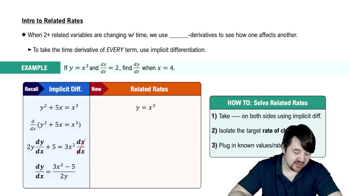
Related Rates

Related rates involve finding the rate at which one quantity changes in relation to another. In this problem, we need to relate the volume of water in the conical tank to the height of the water, using the concept of derivatives to express how the volume changes with respect to time as the height of the water changes.
추천 영상:
가이드 코스
04:16
Intro To Related Rates

Volume of a Cone

The volume of a cone is given by the formula V = (1/3)πr²h, where r is the radius of the base and h is the height. In this scenario, as water fills the conical tank, both the radius and height of the water change, and we need to express the volume in terms of the water height to apply related rates effectively.
추천 영상:
08:29
Example 5: Packaging Design

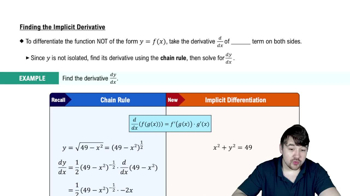
Implicit Differentiation

Implicit differentiation is a technique used to differentiate equations that define one variable in terms of another without explicitly solving for one variable. In this problem, we will differentiate the volume formula with respect to time to find the rate of change of height as the volume of water increases, allowing us to determine how quickly the water level is rising.
추천 영상:
가이드 코스
05:14
Finding The Implicit Derivative