Ch. 3 - Derivatives
Briggs - Calculus: Early Transcendentals 3rd Edition
Briggs3rd EditionCalculus: Early TranscendentalsISBN: 9780136847243당신이 사용하는 게 아니라요?교과서 변경
3장, 문제 53b

Where is the function continuous? Differentiable? Use the graph of f in the figure to do the following. <IMAGE>
b. Find the values of x in (0, 3) at which f is not differentiable.

검증된 단계별 안내
1
Step 1: Understand the concepts of continuity and differentiability. A function is continuous at a point if there is no interruption in the graph at that point. A function is differentiable at a point if it has a defined tangent (slope) at that point, meaning the graph is smooth and not sharp or vertical.
Step 2: Analyze the graph of the function f in the interval (0, 3). Look for any points where the graph has breaks, jumps, or holes, as these indicate points of discontinuity. Also, identify any sharp corners or vertical tangents, as these indicate points where the function is not differentiable.
Step 3: Identify any points of discontinuity in the interval (0, 3). If the graph is continuous throughout this interval, then there are no points of discontinuity.
Step 4: Identify any points where the function is not differentiable in the interval (0, 3). These could be points where the graph has sharp turns or vertical tangents.
Step 5: List the values of x in the interval (0, 3) where the function is not differentiable, based on your analysis of the graph.

비슷한 문제에 대한 검증된 영상 답변:

이 영상 해법은 위 문제에 도움이 된다고 튜터들이 추천한 것입니다.
영상 길이:
1m
도움이 되었나요?

주요 개념

질문에 올바르게 답하기 위해 반드시 이해해야 하는 핵심 개념들은 다음과 같습니다.

Continuity

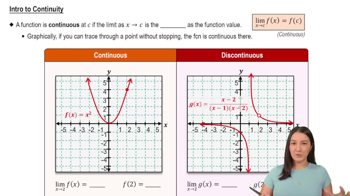
A function is continuous at a point if the limit of the function as it approaches that point equals the function's value at that point. This means there are no breaks, jumps, or holes in the graph of the function at that location. For a function to be continuous over an interval, it must be continuous at every point within that interval.
추천 영상:
05:34
Intro to Continuity

Differentiability

A function is differentiable at a point if it has a defined derivative at that point, which means the function must be smooth and not have any sharp corners or vertical tangents. If a function is not continuous at a point, it cannot be differentiable there. Differentiability implies continuity, but the reverse is not necessarily true.
추천 영상:
가이드 코스
05:53
Finding Differentials

Critical Points

Critical points are values of x where the derivative of a function is either zero or undefined. These points are important for determining where a function may not be differentiable, such as at corners, cusps, or vertical tangents. Identifying critical points helps in analyzing the behavior of the function and understanding its graph.
추천 영상:
04:50
Critical Points