Ch. 4 - Applications of the Derivative
Briggs - Calculus: Early Transcendentals 3rd Edition
Briggs3rd EditionCalculus: Early TranscendentalsISBN: 9780136847243당신이 사용하는 게 아니라요?교과서 변경
4장, 문제 4.9.61

23–68. Indefinite integrals Determine the following indefinite integrals. Check your work by differentiation.


∫ (eˣ⁺²) dx

검증된 단계별 안내
1
Step 1: Recognize that the integral ∫(e^(x+2)) dx involves an exponential function. The general rule for integrating e^(u) is ∫e^(u) du = e^(u) + C, where u is a function of x.
Step 2: Identify the exponent in the given integral. Here, u = x + 2. To apply the rule, we need to check if the derivative of u with respect to x is present in the integral.
Step 3: Compute the derivative of u = x + 2 with respect to x. The derivative is du/dx = 1. Since the derivative is 1, we can directly integrate without additional adjustments.
Step 4: Apply the integration rule for e^(u). The integral becomes e^(x+2) + C, where C is the constant of integration.
Step 5: Verify your result by differentiating e^(x+2) + C. The derivative of e^(x+2) is e^(x+2), and the derivative of the constant C is 0. This confirms that the original integrand is recovered, ensuring the solution is correct.

비슷한 문제에 대한 검증된 영상 답변:

이 영상 해법은 위 문제에 도움이 된다고 튜터들이 추천한 것입니다.
영상 길이:
2m
도움이 되었나요?

주요 개념

질문에 올바르게 답하기 위해 반드시 이해해야 하는 핵심 개념들은 다음과 같습니다.

Indefinite Integrals

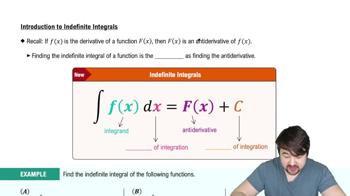
Indefinite integrals represent a family of functions whose derivative is the integrand. They are expressed without limits and include a constant of integration, typically denoted as 'C'. The process of finding an indefinite integral is known as integration, which is the reverse operation of differentiation.
추천 영상:
05:04
Introduction to Indefinite Integrals

Exponential Functions

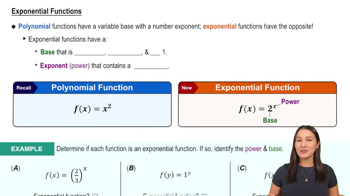
Exponential functions are mathematical functions of the form f(x) = a * e^(bx), where 'e' is the base of natural logarithms, approximately equal to 2.71828. In the context of integration, the integral of e^(kx) is (1/k)e^(kx) + C, which is crucial for solving integrals involving exponential terms.
추천 영상:
6:13
Exponential Functions

Differentiation Check

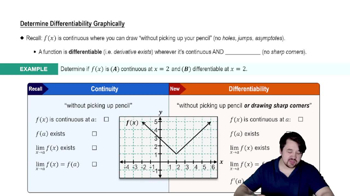
Checking work by differentiation involves taking the derivative of the obtained integral to verify that it matches the original integrand. This process ensures that the integration was performed correctly and helps identify any potential errors in the integration process.
추천 영상:
05:02
Determining Differentiability Graphically
관련 실천
교과서 질문

Linear approximation Find the linear approximation to the following functions at the given point a.


f(x) = 4x² + x; a = 1

292
views

교과서 질문

17–83. Limits Evaluate the following limits. Use l’Hôpital’s Rule when it is convenient and applicable.


lim_x→∞ (ln(3x + 5eˣ)) / (ln(7x + 3e²ˣ)

242
views
교과서 질문

Velocity to position Given the following velocity functions of an object moving along a line, find the position function with the given initial position.


v(t) = 2t + 4; s(0) = 0

74
views
교과서 질문

{Use of Tech} Fixed points An important question about many functions concerns the existence and location of fixed points. A fixed point of f is a value of x that satisfies the equation f(x) = x; it corresponds to a point at which the graph of f intersects the line y = x. Find all the fixed points of the following functions. Use preliminary analysis and graphing to determine good initial approximations.


f(x) = tan x/2 on (-π,π)

179
views
교과서 질문

Finding antiderivatives. Find all the antiderivatives of the following functions. Check your work by taking derivatives.


ƒ(x) = eˣ

79
views
교과서 질문

{Use of Tech} Fixed points An important question about many functions concerns the existence and location of fixed points. A fixed point of f is a value of x that satisfies the equation f(x) = x; it corresponds to a point at which the graph of f intersects the line y = x. Find all the fixed points of the following functions. Use preliminary analysis and graphing to determine good initial approximations.


f(x) = x³ - 3x² + x + 1

215
views