Ch. 4 - Applications of the Derivative
Briggs - Calculus: Early Transcendentals 3rd Edition
Briggs3rd EditionCalculus: Early TranscendentalsISBN: 9780136847243당신이 사용하는 게 아니라요?교과서 변경
4장, 문제 4.9.39

23–68. Indefinite integrals Determine the following indefinite integrals. Check your work by differentiation.


∫ (csc² Θ + 2Θ² - 3Θ) dΘ

검증된 단계별 안내
1
Step 1: Break down the integral into separate terms. The given integral is ∫ (csc² Θ + 2Θ² - 3Θ) dΘ. Using the property of linearity of integration, rewrite it as ∫ csc² Θ dΘ + ∫ 2Θ² dΘ - ∫ 3Θ dΘ.
Step 2: Solve the first term ∫ csc² Θ dΘ. Recall that the integral of csc² Θ is a standard result: ∫ csc² Θ dΘ = -cot Θ + C₁, where C₁ is the constant of integration.
Step 3: Solve the second term ∫ 2Θ² dΘ. Use the power rule for integration: ∫ xⁿ dx = (xⁿ⁺¹)/(n+1) + C. Applying this rule, ∫ 2Θ² dΘ = (2Θ³)/3 + C₂, where C₂ is the constant of integration.
Step 4: Solve the third term ∫ 3Θ dΘ. Again, use the power rule for integration: ∫ x dx = (x²)/2 + C. Applying this rule, ∫ 3Θ dΘ = (3Θ²)/2 + C₃, where C₃ is the constant of integration.
Step 5: Combine the results from all terms. The indefinite integral becomes -cot Θ + (2Θ³)/3 - (3Θ²)/2 + C, where C is the overall constant of integration (combining C₁, C₂, and C₃). To check your work, differentiate the result and verify that it matches the original integrand.

비슷한 문제에 대한 검증된 영상 답변:

이 영상 해법은 위 문제에 도움이 된다고 튜터들이 추천한 것입니다.
영상 길이:
3m
도움이 되었나요?

주요 개념

질문에 올바르게 답하기 위해 반드시 이해해야 하는 핵심 개념들은 다음과 같습니다.

Indefinite Integrals

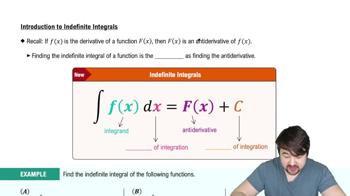
Indefinite integrals represent a family of functions whose derivative is the integrand. They are expressed without limits and include a constant of integration, typically denoted as 'C'. The process of finding an indefinite integral is often referred to as antiderivation, where we seek a function F(Θ) such that F'(Θ) equals the integrand.
추천 영상:
가이드 코스
05:04
Introduction to Indefinite Integrals

Basic Integration Rules

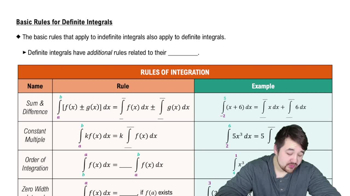
To solve indefinite integrals, one must be familiar with basic integration rules, such as the power rule, which states that ∫x^n dx = (x^(n+1))/(n+1) + C for n ≠ -1. Additionally, specific functions like trigonometric functions have their own integration formulas, such as ∫csc²(Θ) dΘ = -cot(Θ) + C. Mastery of these rules is essential for effectively computing integrals.
추천 영상:
가이드 코스
06:07
Basic Rules for Definite Integrals

Verification by Differentiation

After finding an indefinite integral, it is crucial to verify the result by differentiation. This involves taking the derivative of the antiderivative obtained and checking if it equals the original integrand. This step ensures that the integration process was performed correctly and helps reinforce the relationship between differentiation and integration, as they are inverse operations.
추천 영상:
가이드 코스
05:53
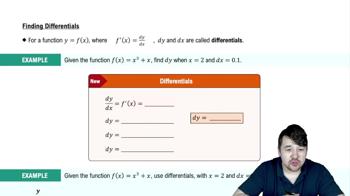
Finding Differentials