Ch. 4 - Applications of the Derivative
Briggs - Calculus: Early Transcendentals 3rd Edition
Briggs3rd EditionCalculus: Early TranscendentalsISBN: 9780136847243당신이 사용하는 게 아니라요?교과서 변경
4장, 문제 4.R.34

24–34. Curve sketching Use the guidelines given in Section 4.4 to make a complete graph of the following functions on their domains or on the given interval. Use a graphing utility to check your work.


{Use of Tech} ƒ(x) = x (x -1)e⁻ˣ

검증된 단계별 안내
1
Identify the domain of the function. Since the function is a product of polynomials and an exponential function, it is defined for all real numbers.
Find the first derivative, f'(x), to determine the critical points and intervals of increase and decrease. Use the product rule and chain rule: f'(x) = d/dx [x(x-1)e^(-x)].
Set the first derivative equal to zero to find critical points: f'(x) = 0. Solve for x to find where the function changes from increasing to decreasing or vice versa.
Find the second derivative, f''(x), to determine concavity and points of inflection. Use the product rule and chain rule again: f''(x) = d/dx [f'(x)].
Analyze the behavior of the function as x approaches positive and negative infinity to determine end behavior. Consider the limits of f(x) as x approaches infinity and negative infinity.

비슷한 문제에 대한 검증된 영상 답변:

이 영상 해법은 위 문제에 도움이 된다고 튜터들이 추천한 것입니다.
영상 길이:
15m
도움이 되었나요?

주요 개념

질문에 올바르게 답하기 위해 반드시 이해해야 하는 핵심 개념들은 다음과 같습니다.

Curve Sketching

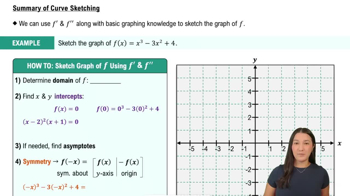
Curve sketching involves analyzing a function's behavior to create a visual representation of its graph. This includes determining key features such as intercepts, asymptotes, intervals of increase and decrease, and concavity. By applying calculus concepts like derivatives, one can identify critical points and inflection points, which are essential for accurately sketching the curve.
추천 영상:
11:41
Summary of Curve Sketching

Derivatives

Derivatives represent the rate of change of a function and are fundamental in understanding its behavior. By finding the first derivative, one can determine where the function is increasing or decreasing, while the second derivative helps identify concavity and points of inflection. These insights are crucial for sketching the graph accurately and understanding the function's overall shape.
추천 영상:

Exponential Functions

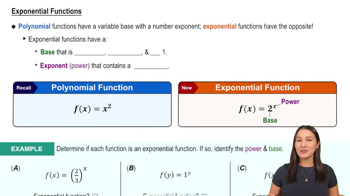
Exponential functions, such as e^(-x), exhibit unique properties, including rapid growth or decay. In the given function f(x) = x(x - 1)e^(-x), the exponential component influences the function's behavior as x approaches infinity or negative infinity. Understanding how exponential functions interact with polynomial terms is essential for predicting the function's end behavior and overall graph shape.
추천 영상:
6:13
Exponential Functions