Ch. 4 - Applications of the Derivative
Briggs - Calculus: Early Transcendentals 3rd Edition
Briggs3rd EditionCalculus: Early TranscendentalsISBN: 9780136847243당신이 사용하는 게 아니라요?교과서 변경
4장, 문제 4.R.45

45–46. Linear approximation


a. Find the linear approximation to f at the given point a.
b. Use your answer from part (a) to estimate the given function value. Does your approximation underestimate or overestimate the exact function value?


ƒ(x) = x²⸍³ ; a =27; ƒ(29)

검증된 단계별 안내
1
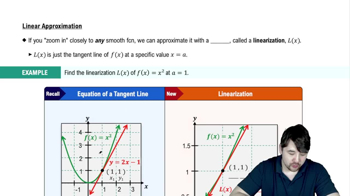
To find the linear approximation of a function f(x) at a point a, we use the formula L(x) = f(a) + f'(a)(x - a). This is derived from the tangent line to the curve at x = a.
First, calculate f(a) for the given function f(x) = x^(2/3) at a = 27. This involves evaluating 27^(2/3).
Next, find the derivative f'(x) of the function f(x) = x^(2/3). Use the power rule for derivatives: if f(x) = x^n, then f'(x) = n*x^(n-1). Here, n = 2/3.
Evaluate the derivative at the point a = 27 to find f'(27). Substitute x = 27 into the derivative expression you found in the previous step.
Now, substitute f(a), f'(a), and a into the linear approximation formula L(x) = f(a) + f'(a)(x - a) to find the linear approximation L(x) at x = 29. Compare this approximation to the actual value of f(29) to determine if it is an underestimate or overestimate.

비슷한 문제에 대한 검증된 영상 답변:

이 영상 해법은 위 문제에 도움이 된다고 튜터들이 추천한 것입니다.
영상 길이:
6m
도움이 되었나요?

주요 개념

질문에 올바르게 답하기 위해 반드시 이해해야 하는 핵심 개념들은 다음과 같습니다.

Linear Approximation

Linear approximation is a method used to estimate the value of a function near a given point using the tangent line at that point. It is based on the idea that a function can be closely approximated by a linear function (a straight line) when the input values are near a specific point. The formula for linear approximation is f(x) ≈ f(a) + f'(a)(x - a), where f'(a) is the derivative of the function at point a.
추천 영상:

Derivative

The derivative of a function at a point measures the rate at which the function's value changes as its input changes. It is a fundamental concept in calculus that provides information about the slope of the tangent line to the function at that point. In the context of linear approximation, the derivative is crucial because it determines the slope of the tangent line, which is used to create the linear approximation.
추천 영상:

Estimation and Error Analysis

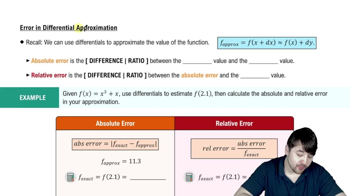
Estimation in calculus involves using methods like linear approximation to predict the value of a function without calculating it exactly. After estimating, it is important to analyze whether the approximation underestimates or overestimates the actual function value. This can be determined by examining the concavity of the function or the behavior of the derivative, which helps in understanding the accuracy of the approximation.
추천 영상:
가이드 코스
04:57
Determining Error and Relative Error