Ch. 4 - Applications of the Derivative
Briggs - Calculus: Early Transcendentals 3rd Edition
Briggs3rd EditionCalculus: Early TranscendentalsISBN: 9780136847243당신이 사용하는 게 아니라요?교과서 변경
4장, 문제 4.6.67

Differentials Consider the following functions and express the relationship between a small change in x and the corresponding change in y in the form dy = f'(x)dx.


f(x) = 3x³ - 4x

검증된 단계별 안내
1
First, identify the function given: \( f(x) = 3x^3 - 4x \). This is a polynomial function.
To find the differential \( dy \), we need to compute the derivative of \( f(x) \) with respect to \( x \). The derivative, \( f'(x) \), represents the rate of change of \( y \) with respect to \( x \).
Apply the power rule to differentiate \( f(x) \). The power rule states that if \( f(x) = ax^n \), then \( f'(x) = n \cdot ax^{n-1} \).
Differentiate each term separately: For \( 3x^3 \), the derivative is \( 9x^2 \). For \( -4x \), the derivative is \( -4 \). Therefore, \( f'(x) = 9x^2 - 4 \).
Express the relationship between the small change in \( x \) and the corresponding change in \( y \) using differentials: \( dy = f'(x)dx = (9x^2 - 4)dx \). This equation shows how a small change in \( x \) results in a change in \( y \).

비슷한 문제에 대한 검증된 영상 답변:

이 영상 해법은 위 문제에 도움이 된다고 튜터들이 추천한 것입니다.
영상 길이:
1m
도움이 되었나요?

주요 개념

질문에 올바르게 답하기 위해 반드시 이해해야 하는 핵심 개념들은 다음과 같습니다.

Differentials

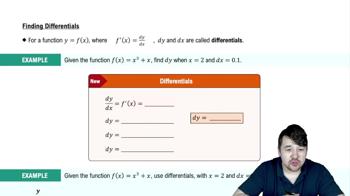
Differentials represent the infinitesimally small changes in variables. In calculus, the differential of a function, denoted as dy, indicates how much the function's output changes in response to a small change in its input, dx. This concept is foundational for understanding how functions behave locally and is crucial for applications in optimization and approximation.
추천 영상:
가이드 코스
05:53
Finding Differentials

Derivative

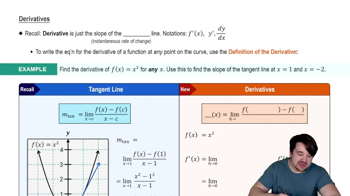
The derivative of a function, denoted as f'(x), measures the rate at which the function's value changes as its input changes. It is defined as the limit of the average rate of change of the function over an interval as the interval approaches zero. The derivative provides essential information about the function's slope and is used to find tangents, optimize functions, and analyze motion.
추천 영상:

Chain Rule

The chain rule is a fundamental theorem in calculus that allows us to differentiate composite functions. It states that if a function y = f(g(x)) is composed of two functions, the derivative can be found by multiplying the derivative of the outer function f with the derivative of the inner function g. This rule is essential for handling more complex functions and understanding how changes in one variable affect another.
추천 영상:
05:02
Intro to the Chain Rule