Ch. 4 - Applications of the Derivative
Briggs - Calculus: Early Transcendentals 3rd Edition
Briggs3rd EditionCalculus: Early TranscendentalsISBN: 9780136847243당신이 사용하는 게 아니라요?교과서 변경
4장, 문제 4.6.68

Differentials Consider the following functions and express the relationship between a small change in x and the corresponding change in y in the form dy = f'(x)dx.


f(x) = sin⁻¹ x

검증된 단계별 안내
1
First, understand that the problem is asking for the differential dy in terms of dx for the function f(x) = sin⁻¹(x). The differential dy represents the change in y corresponding to a small change in x, denoted as dx.
To find dy, we need to determine the derivative of the function f(x) = sin⁻¹(x) with respect to x. The derivative of sin⁻¹(x) is given by f'(x) = \( \frac{1}{\sqrt{1-x^2}} \).
Now, express the differential dy in terms of dx using the formula dy = f'(x)dx. Substitute the derivative we found into this formula.
This gives us dy = \( \frac{1}{\sqrt{1-x^2}} \) dx. This equation shows how a small change in x (dx) affects the change in y (dy) for the function f(x) = sin⁻¹(x).
Finally, remember that this relationship is valid for values of x within the domain of the inverse sine function, which is -1 ≤ x ≤ 1. This ensures that the expression under the square root is non-negative.

비슷한 문제에 대한 검증된 영상 답변:

이 영상 해법은 위 문제에 도움이 된다고 튜터들이 추천한 것입니다.
영상 길이:
2m
도움이 되었나요?

주요 개념

질문에 올바르게 답하기 위해 반드시 이해해야 하는 핵심 개념들은 다음과 같습니다.

Differentials

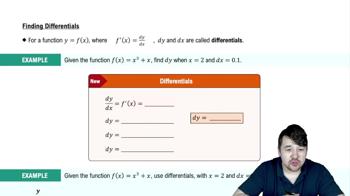
Differentials represent the infinitesimal changes in variables. In calculus, if y is a function of x, the differential dy is defined as the product of the derivative f'(x) and the differential dx, which represents a small change in x. This relationship helps in approximating how a small change in x affects the change in y.
추천 영상:
가이드 코스
05:53
Finding Differentials

Derivative

The derivative of a function at a point measures the rate at which the function's value changes as its input changes. It is denoted as f'(x) and is calculated as the limit of the average rate of change of the function as the interval approaches zero. In the context of differentials, the derivative provides the necessary slope to relate changes in x and y.
추천 영상:

Inverse Function

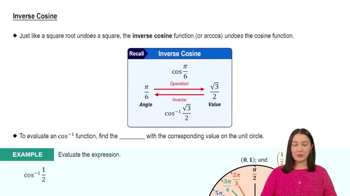
An inverse function reverses the effect of the original function. For example, the inverse of f(x) = sin(x) is f⁻¹(x) = sin⁻¹(x), which takes a value from the range of the sine function and returns the corresponding angle. Understanding inverse functions is crucial when dealing with their derivatives, as the derivative of an inverse function can be found using the formula f⁻¹'(y) = 1 / f'(x) where y = f(x).
추천 영상:
4:49
Inverse Cosine
관련 실천
교과서 질문

Evaluate the following limits. Use l’Hôpital’s Rule when it is convenient and applicable.

lim_x→π/2⁻ (π - 2x) tan x  

164
views

교과서 질문

Shipping crates A square-based, box-shaped shipping crate is designed to have a volume of 16 ft³. The material used to make the base costs twice as much (per square foot) as the material in the sides, and the material used to make the top costs half as much (per square foot) as the material in the sides. What are the dimensions of the crate that minimize the cost of materials?

286
views
교과서 질문

{Use of Tech} Special curves The following classical curves have been studied by generations of mathematicians. Use analytical methods (including implicit differentiation) and a graphing utility to graph the curves. Include as much detail as possible.


x³ + y³ = 3xy (Folium of Descartes)

162
views
교과서 질문

Snell’s Law Suppose a light source at A is in a medium in which light travels at a speed v₁ and that point B is in a medium in which light travels at a speed v₂ (see figure). Using Fermat’s Principle, which states that light travels along the path that requires the minimum travel time (Exercise 55), show that the path taken between points A and B satisfies (sinΘ₁/v₁ = (sin Θ₂) /v₂ . <IMAGE>

291
views
교과서 질문

Evaluate the following limits. Use l’Hôpital’s Rule when it is convenient and applicable.


lim_x→ 1 (x² + 2x) / (x +3)

271
views
교과서 질문

23–68. Indefinite integrals Determine the following indefinite integrals. Check your work by differentiation.


∫ (sec² x - 1) dx

90
views