Ch. 4 - Applications of the Derivative
Briggs - Calculus: Early Transcendentals 3rd Edition
Briggs3rd EditionCalculus: Early TranscendentalsISBN: 9780136847243당신이 사용하는 게 아니라요?교과서 변경
4장, 문제 4.9.7

Give the antiderivatives of 1/x.

검증된 단계별 안내
1
Recognize that the function 1/x is a standard form for which the antiderivative is well-known. The antiderivative of 1/x is related to the natural logarithm function.
Recall the rule for the antiderivative of 1/x: ∫(1/x) dx = ln|x| + C, where ln|x| represents the natural logarithm of the absolute value of x, and C is the constant of integration.
Understand why the absolute value is necessary: The natural logarithm function, ln(x), is only defined for positive values of x. To account for both positive and negative values of x, we use ln|x|.
Write the general form of the antiderivative: ∫(1/x) dx = ln|x| + C. This represents the family of functions whose derivative is 1/x.
Conclude that the antiderivative of 1/x is ln|x| + C, emphasizing the importance of including the constant of integration (C) to represent all possible antiderivatives.

비슷한 문제에 대한 검증된 영상 답변:

이 영상 해법은 위 문제에 도움이 된다고 튜터들이 추천한 것입니다.
영상 길이:
2m

주요 개념

질문에 올바르게 답하기 위해 반드시 이해해야 하는 핵심 개념들은 다음과 같습니다.

Antiderivative

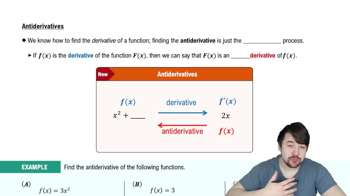
An antiderivative of a function is another function whose derivative is the original function. In calculus, finding the antiderivative is a fundamental operation, often referred to as integration. The process of determining an antiderivative can yield a family of functions differing by a constant, known as the constant of integration.
추천 영상:
가이드 코스
05:50
Antiderivatives

Natural Logarithm

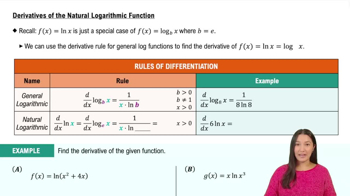
The natural logarithm, denoted as ln(x), is the logarithm to the base e, where e is approximately 2.71828. It is particularly important in calculus because the derivative of ln(x) is 1/x, making it the antiderivative of 1/x. Understanding the properties of logarithms is essential for solving integrals involving exponential functions.
추천 영상:
05:18
Derivative of the Natural Logarithmic Function

Integration Constant

When finding antiderivatives, the result includes an integration constant (C) because the derivative of a constant is zero. This means that multiple functions can have the same derivative, differing only by a constant value. Recognizing the importance of this constant is crucial for expressing the general solution to an indefinite integral.
추천 영상:
가이드 코스
06:18
Integration by Parts for Definite Integrals