

Ch. 4 - Applications of the Derivative
Briggs - Calculus: Early Transcendentals 3rd Edition
Briggs3rd EditionCalculus: Early TranscendentalsISBN: 9780136847243당신이 사용하는 게 아니라요?교과서 변경
4장, 문제 4.4.46

Graphing functions Use the guidelines of this section to make a complete graph of f.


f(x) = e⁻ˣ²/₂

검증된 단계별 안내
1
Identify the function: The given function is \( f(x) = e^{-x^2/2} \). This is a Gaussian function, which is a type of bell curve centered at the origin.
Determine the domain and range: The domain of \( f(x) \) is all real numbers, \( (-\infty, \infty) \), because the exponential function is defined for all real numbers. The range is \( (0, 1] \) because \( e^{-x^2/2} \) is always positive and reaches a maximum value of 1 when \( x = 0 \).
Find the symmetry: The function \( f(x) = e^{-x^2/2} \) is an even function because \( f(-x) = f(x) \). This means the graph is symmetric with respect to the y-axis.
Determine the critical points: To find critical points, compute the derivative \( f'(x) \) and set it to zero. The derivative is \( f'(x) = -x e^{-x^2/2} \). Setting \( f'(x) = 0 \) gives \( x = 0 \) as the only critical point. Since \( f'(x) \) changes sign around \( x = 0 \), this is a maximum point.
Analyze the behavior at infinity: As \( x \to \pm\infty \), \( e^{-x^2/2} \to 0 \). This means the graph approaches the x-axis but never touches it, indicating horizontal asymptotes at \( y = 0 \).

비슷한 문제에 대한 검증된 영상 답변:

이 영상 해법은 위 문제에 도움이 된다고 튜터들이 추천한 것입니다.
영상 길이:
6m
도움이 되었나요?

주요 개념

질문에 올바르게 답하기 위해 반드시 이해해야 하는 핵심 개념들은 다음과 같습니다.

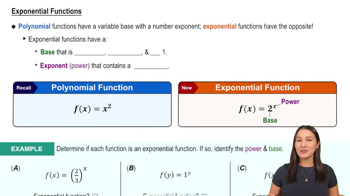
Exponential Functions

Exponential functions are mathematical functions of the form f(x) = a^x, where 'a' is a constant. In the given function f(x) = e^(-x²/2), 'e' is the base of the natural logarithm, approximately equal to 2.71828. Understanding the behavior of exponential functions, especially with negative exponents, is crucial for graphing as they determine the function's growth or decay.
추천 영상:
6:13
Exponential Functions

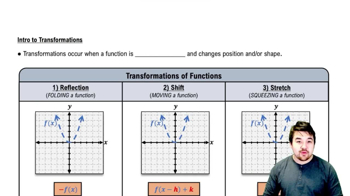
Transformation of Functions

Transformations involve shifting, stretching, or compressing the graph of a function. For f(x) = e^(-x²/2), the exponent -x²/2 indicates a horizontal reflection and a vertical compression. Recognizing these transformations helps in predicting the shape and orientation of the graph, which is essential for accurate plotting.
추천 영상:
가이드 코스
5:25
Intro to Transformations

Critical Points and Symmetry

Critical points, where the derivative is zero or undefined, help identify local maxima, minima, or points of inflection. For f(x) = e^(-x²/2), symmetry about the y-axis is evident due to the even power of x. Analyzing these aspects allows for a more complete understanding of the function's behavior and assists in creating a detailed graph.
추천 영상:
04:50
Critical Points