

Ch. 4 - Applications of the Derivative
Briggs - Calculus: Early Transcendentals 3rd Edition
Briggs3rd EditionCalculus: Early TranscendentalsISBN: 9780136847243당신이 사용하는 게 아니라요?교과서 변경
4장, 문제 4.1.31

Locating critical points Find the critical points of the following functions. Assume a is a nonzero constant.


ƒ(t) = t/ t² + 1

검증된 단계별 안내
1
To find the critical points of the function \( f(t) = \frac{t}{t^2 + 1} \), we first need to find its derivative \( f'(t) \).
Use the quotient rule for differentiation, which states that if \( f(t) = \frac{u(t)}{v(t)} \), then \( f'(t) = \frac{u'(t)v(t) - u(t)v'(t)}{(v(t))^2} \). Here, \( u(t) = t \) and \( v(t) = t^2 + 1 \).
Calculate \( u'(t) \) and \( v'(t) \). We have \( u'(t) = 1 \) and \( v'(t) = 2t \).
Substitute \( u(t) \), \( v(t) \), \( u'(t) \), and \( v'(t) \) into the quotient rule formula to find \( f'(t) = \frac{(1)(t^2 + 1) - (t)(2t)}{(t^2 + 1)^2} \). Simplify the expression to get \( f'(t) = \frac{1 - t^2}{(t^2 + 1)^2} \).
Set \( f'(t) = 0 \) to find the critical points. This gives \( 1 - t^2 = 0 \). Solve for \( t \) to find the critical points.

비슷한 문제에 대한 검증된 영상 답변:

이 영상 해법은 위 문제에 도움이 된다고 튜터들이 추천한 것입니다.
영상 길이:
4m

주요 개념

질문에 올바르게 답하기 위해 반드시 이해해야 하는 핵심 개념들은 다음과 같습니다.

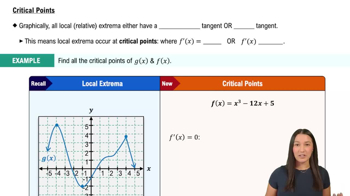
Critical Points

Critical points of a function occur where its derivative is either zero or undefined. These points are essential for identifying local maxima, minima, and points of inflection. To find critical points, one typically differentiates the function and solves for the values of the variable that satisfy these conditions.
추천 영상:
04:50
Critical Points

Derivative

The derivative of a function measures the rate at which the function's value changes with respect to changes in its input. It is a fundamental concept in calculus that provides information about the function's slope and behavior. For the function given, finding the derivative will help identify where the critical points are located.
추천 영상:

Rational Functions

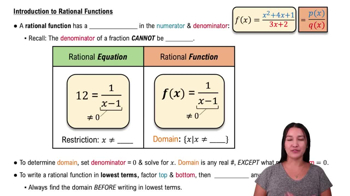
A rational function is a ratio of two polynomials. In the given function, ƒ(t) = t / (t² + 1), the numerator is a polynomial of degree one, and the denominator is a polynomial of degree two. Understanding the properties of rational functions, such as their domain and behavior at asymptotes, is crucial for analyzing their critical points and overall shape.
추천 영상:
6:04
Intro to Rational Functions
관련 실천
교과서 질문

{Use of Tech} Estimating roots The values of various roots can be approximated using Newton’s method. For example, to approximate the value of ³√10, we let x = ³√10 and cube both sides of the equation to obtain x³ = 10, or x³ - 10 = 0. Therefore, ³√10 is a root of p(x) = x³ - 10, which we can approximate by applying Newton’s method. Approximate each value of r by first finding a polynomial with integer coefficients that has a root r. Use an appropriate value of x₀ and stop calculating approximations when two successive approximations agree to five digits to the right of the decimal point after rounding.


r = 7¹/⁴

220
views
교과서 질문

Absolute maxima and minima Determine the location and value of the absolute extreme values of ƒ on the given interval, if they exist.


ƒ(x) = (4x³/3) + 5x² - 6x on [0,5]

186
views
교과서 질문

Increasing and decreasing functions. Find the intervals on which f is increasing and the intervals on which it is decreasing.


f(x) = eˣ/(e²ᵉ + 1)

234
views
교과서 질문

Rectangles beneath a parabola A rectangle is constructed with its base on the x-axis and two of its vertices on the parabola y = 48 - x². What are the dimensions of the rectangle with the maximum area? What is the area?

339
views
교과서 질문

A graph of ƒ and the lines tangent to ƒ at x = 1, 2 and 3 are given. If x₀ = 3, find the values of x₁, x₂, and x₃, that are obtained by applying Newton’s method. <IMAGE>

193
views
교과서 질문

Acceleration to position Given the following acceleration functions of an object moving along a line, find the position function with the given initial velocity and position.


a(t) = -32; v(0) = 20, s(0) = 0

105
views