Ch. 4 - Applications of the Derivative
Briggs - Calculus: Early Transcendentals 3rd Edition
Briggs3rd EditionCalculus: Early TranscendentalsISBN: 9780136847243당신이 사용하는 게 아니라요?교과서 변경
4장, 문제 19

Use ƒ' and ƒ" to complete parts (a) and (b). 


a. Find the intervals on which f is increasing and the intervals on which it is decreasing.


b. Find the intervals on which f is concave up and the intervals on which it is concave down.


ƒ(x) = x⁹/9 + 3x⁵ - 16x

검증된 단계별 안내
1
First, find the first derivative ƒ'(x) of the function ƒ(x) = \( \frac{x^9}{9} + 3x^5 - 16x \). Use the power rule for differentiation: \( \frac{d}{dx} x^n = nx^{n-1} \).
Calculate ƒ'(x): \( \frac{d}{dx} \left( \frac{x^9}{9} \right) = x^8 \), \( \frac{d}{dx} (3x^5) = 15x^4 \), and \( \frac{d}{dx} (-16x) = -16 \). Therefore, ƒ'(x) = x^8 + 15x^4 - 16.
To find the intervals where ƒ is increasing or decreasing, solve ƒ'(x) = 0 to find critical points. Analyze the sign of ƒ'(x) in each interval determined by these critical points.
Next, find the second derivative ƒ''(x) to determine concavity. Differentiate ƒ'(x): \( \frac{d}{dx} (x^8) = 8x^7 \), \( \frac{d}{dx} (15x^4) = 60x^3 \), and \( \frac{d}{dx} (-16) = 0 \). Thus, ƒ''(x) = 8x^7 + 60x^3.
To find intervals of concavity, solve ƒ''(x) = 0 to find inflection points. Analyze the sign of ƒ''(x) in each interval determined by these inflection points to determine where the function is concave up or concave down.

비슷한 문제에 대한 검증된 영상 답변:

이 영상 해법은 위 문제에 도움이 된다고 튜터들이 추천한 것입니다.
영상 길이:
10m

주요 개념

질문에 올바르게 답하기 위해 반드시 이해해야 하는 핵심 개념들은 다음과 같습니다.

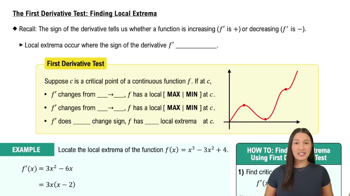
First Derivative Test

The First Derivative Test involves analyzing the first derivative of a function, ƒ'(x), to determine where the function is increasing or decreasing. If ƒ'(x) > 0 on an interval, the function is increasing; if ƒ'(x) < 0, it is decreasing. Critical points, where ƒ'(x) = 0 or is undefined, are key to identifying these intervals.
추천 영상:
07:09
The First Derivative Test: Finding Local Extrema

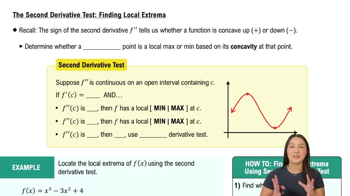
Second Derivative Test

The Second Derivative Test uses the second derivative, ƒ''(x), to assess the concavity of a function. If ƒ''(x) > 0, the function is concave up, indicating that the slope of the tangent line is increasing. Conversely, if ƒ''(x) < 0, the function is concave down, suggesting that the slope is decreasing. Points where ƒ''(x) = 0 may indicate inflection points.
추천 영상:
06:02
The Second Derivative Test: Finding Local Extrema

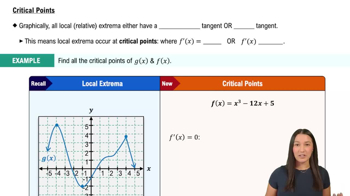
Critical Points

Critical points are values of x where the first derivative ƒ'(x) is zero or undefined. These points are essential for determining intervals of increase and decrease, as well as for analyzing concavity. By evaluating the behavior of the function around these points, one can classify them as local maxima, minima, or points of inflection.
추천 영상:
04:50
Critical Points