
Ch. 4 - Applications of the Derivative
Briggs - Calculus: Early Transcendentals 3rd Edition
Briggs3rd EditionCalculus: Early TranscendentalsISBN: 9780136847243당신이 사용하는 게 아니라요?교과서 변경
4장, 문제 4.8.37c

{Use of Tech} A damped oscillator The displacement of an object as it bounces vertically up and down on a spring is given by y(t) = 2.5e⁻ᵗ cos 2t, where the initial displacement is y(0) = 2.5 and y = 0 corresponds to the rest position (see figure). <IMAGE>


c. Find the time at which the object passes the rest position for the second time.

검증된 단계별 안내
1
First, understand the function y(t) = 2.5e⁻ᵗ cos 2t. This represents a damped oscillator, where the term 2.5e⁻ᵗ is the damping factor and cos 2t is the oscillatory component.
To find when the object passes the rest position, set y(t) = 0 and solve for t. This means solving the equation 2.5e⁻ᵗ cos 2t = 0.
Since 2.5e⁻ᵗ is never zero for any real value of t, focus on the oscillatory part: cos 2t = 0. The cosine function is zero at odd multiples of π/2, so set 2t = (2n+1)π/2, where n is an integer.
Solve for t: t = (2n+1)π/4. This gives the times at which the object passes the rest position.
To find the second time the object passes the rest position, use n = 1 (since n = 0 corresponds to the first time). Substitute n = 1 into the equation t = (2n+1)π/4 to find the second time.

비슷한 문제에 대한 검증된 영상 답변:

이 영상 해법은 위 문제에 도움이 된다고 튜터들이 추천한 것입니다.
영상 길이:
5m

주요 개념

질문에 올바르게 답하기 위해 반드시 이해해야 하는 핵심 개념들은 다음과 같습니다.

Damped Oscillator

A damped oscillator is a system in which the amplitude of oscillation decreases over time due to energy loss, often modeled by an exponential decay function. In the given equation, the term '2.5e⁻ᵗ' represents this damping effect, indicating that the displacement diminishes as time progresses.
추천 영상:
03:07
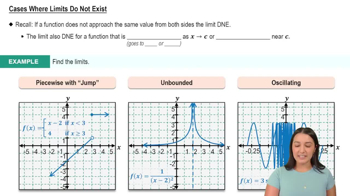
Cases Where Limits Do Not Exist

Cosine Function in Oscillations

The cosine function is fundamental in describing periodic motion, such as oscillations. In the equation y(t) = 2.5e⁻ᵗ cos 2t, the 'cos 2t' component indicates the oscillatory behavior of the system, with '2' representing the angular frequency, which affects the speed of oscillation.
추천 영상:
가이드 코스
5:53
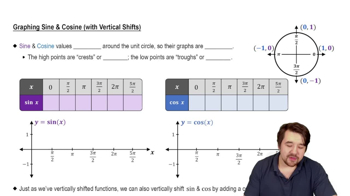
Graph of Sine and Cosine Function

Finding Roots of the Function

To determine when the object passes the rest position (y = 0), we need to find the roots of the function y(t). This involves solving the equation 2.5e⁻ᵗ cos 2t = 0, which occurs when cos 2t = 0, leading to specific values of t that correspond to the times the object crosses the rest position.
추천 영상:
05:21
Finding Limits by Direct Substitution
관련 실천
교과서 질문

107–110. {Use of Tech} Motion with gravity Consider the following descriptions of the vertical motion of an object subject only to the acceleration due to gravity. Begin with the acceleration equation a(t) = v' (t) = -g , where g = 9.8 m/s² .

b. Find the position of the object for all relevant times. 

A payload is released at an elevation of 400 m from a hot-air balloon that is rising at a rate of 10 m/s.

43
views
교과서 질문

{Use of Tech} Elliptic curves The equation y² = x³ - ax + 3, where a is a parameter, defines a well-known family of elliptic curves.


c. By experimentation, determine the approximate value of a (3 < a < 4)at which the graph separates into two curves.

263
views
교과서 질문

Population models The population of a species is given by the function P(t) = Kt²/(t² + b) , where t ≥ 0 is measured in years and K and b are positive real numbers.


c. For arbitrary positive values of K and b, when does the maximum growth rate occur (in terms of K and b)?

338
views
교과서 질문

107–110. {Use of Tech} Motion with gravity Consider the following descriptions of the vertical motion of an object subject only to the acceleration due to gravity. Begin with the acceleration equation a(t) = v' (t) = -g , where g = 9.8 m/s² .

c. Find the time when the object reaches its highest point. What is the height? 

A payload is released at an elevation of 400 m from a hot-air balloon that is rising at a rate of 10 m/s.

50
views
교과서 질문

{Use of Tech} Fixed points of quadratics and quartics Let f(x) = ax(1 -x), where a is a real number and 0 ≤ a ≤ 1. Recall that the fixed point of a function is a value of x such that f(x) = x (Exercises 48–51). 


b. Consider the polynomial g(x) = f(f(x)). Write g in terms of a and powers of x. What is its degree?

341
views
교과서 질문

Explain why or why not Determine whether the following statements are true and give an explanation or counterexample.


c. If f(x) = mx + b, then the linear approximation to f at any point is L(x) = f(x).

186
views