Ch. 4 - Applications of the Derivative
Briggs - Calculus: Early Transcendentals 3rd Edition
Briggs3rd EditionCalculus: Early TranscendentalsISBN: 9780136847243당신이 사용하는 게 아니라요?교과서 변경
4장, 문제 4.R.118b

{Use of Tech} A family of superexponential functions Let ƒ(x) = (a + x)ˣ , where a > 0.


b. Describe the end behavior of f (near the left boundary of its domain and as x→∞).

검증된 단계별 안내
1
First, identify the domain of the function ƒ(x) = (a + x)ˣ. Since the base (a + x) must be positive, the domain is x > -a.
Consider the behavior of ƒ(x) as x approaches the left boundary of its domain, which is x approaching -a from the right. As x gets closer to -a, the base (a + x) approaches zero, and the exponent x approaches -a. This results in the function approaching zero.
Next, analyze the behavior of ƒ(x) as x approaches infinity. As x becomes very large, both the base (a + x) and the exponent x increase. The function (a + x)ˣ grows rapidly, leading to superexponential growth.
Understand that superexponential growth means the function increases faster than exponential functions, due to the variable being both in the base and the exponent.
Summarize the end behavior: Near the left boundary of its domain, ƒ(x) approaches zero as x approaches -a. As x approaches infinity, ƒ(x) exhibits superexponential growth, increasing very rapidly.

비슷한 문제에 대한 검증된 영상 답변:

이 영상 해법은 위 문제에 도움이 된다고 튜터들이 추천한 것입니다.
영상 길이:
6m

주요 개념

질문에 올바르게 답하기 위해 반드시 이해해야 하는 핵심 개념들은 다음과 같습니다.

Superexponential Functions

Superexponential functions, like f(x) = (a + x)ˣ, grow faster than exponential functions as x increases. This means that as x approaches infinity, the function's value increases at an accelerating rate, which is crucial for understanding its end behavior.
추천 영상:
가이드 코스
06:21
Properties of Functions

End Behavior

End behavior refers to the behavior of a function as the input approaches certain limits, such as negative or positive infinity. For f(x) = (a + x)ˣ, analyzing end behavior involves determining how the function behaves as x approaches the left boundary of its domain and as x approaches infinity.
추천 영상:
03:07
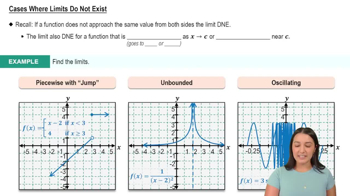
Cases Where Limits Do Not Exist

Domain of the Function

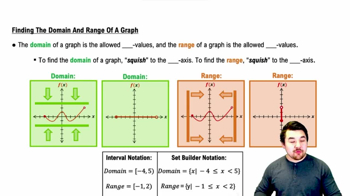
The domain of a function is the set of all possible input values (x) for which the function is defined. For f(x) = (a + x)ˣ, the domain is all real numbers greater than -a, which affects how we analyze the function's behavior at the left boundary and as x increases.
추천 영상:
가이드 코스
5:10
Finding the Domain and Range of a Graph