Ch. 4 - Applications of the Derivative
Briggs - Calculus: Early Transcendentals 3rd Edition
Briggs3rd EditionCalculus: Early TranscendentalsISBN: 9780136847243당신이 사용하는 게 아니라요?교과서 변경
4장, 문제 4.5.54b

{Use of Tech} Basketball shot A basketball is shot with an initial velocity of v ft/s at an angle of 45° to the floor. The center of the basketball is 8 ft above the floor at a horizontal distance of 18 feet from the center of the basketball hoop when it is released. The height h (in feet) of the center of the basketball after it has traveled a horizontal distance of x feet is modeled by the function h(x) = 32x² / v² + x + 8 (see figure). <IMAGE>


b. During the flight of the basketball, show that the distance s from the center of the basketball to the front of the hoop is s = √ (x - 17.25)² + ( -(4x² / 81) + x - 2)² (Hint: The diameter of the basketball hoop is 18 inches.) 

검증된 단계별 안내
1
First, understand the problem: We need to show that the distance s from the center of the basketball to the front of the hoop is given by the formula s = √((x - 17.25)² + (-(4x² / 81) + x - 2)²).
Recognize that the formula for s involves calculating the horizontal and vertical distances between the basketball and the hoop. The horizontal distance is given by (x - 17.25), where x is the horizontal distance traveled by the basketball.
The vertical distance is given by the expression (-(4x² / 81) + x - 2). This expression represents the difference in height between the basketball and the hoop as the basketball travels horizontally.
To derive the formula for s, use the Pythagorean theorem. The distance s is the hypotenuse of a right triangle where one leg is the horizontal distance (x - 17.25) and the other leg is the vertical distance (-(4x² / 81) + x - 2).
Combine these distances using the Pythagorean theorem: s = √((horizontal distance)² + (vertical distance)²) = √((x - 17.25)² + (-(4x² / 81) + x - 2)²). This confirms the given formula for s.

비슷한 문제에 대한 검증된 영상 답변:

이 영상 해법은 위 문제에 도움이 된다고 튜터들이 추천한 것입니다.
영상 길이:
5m

주요 개념

질문에 올바르게 답하기 위해 반드시 이해해야 하는 핵심 개념들은 다음과 같습니다.

Projectile Motion

Projectile motion describes the motion of an object thrown or projected into the air, subject to only the acceleration of gravity. It involves two components: horizontal motion at a constant velocity and vertical motion under constant acceleration due to gravity. Understanding this helps in analyzing the basketball's trajectory and its height at any given horizontal distance.
추천 영상:
가이드 코스
06:51
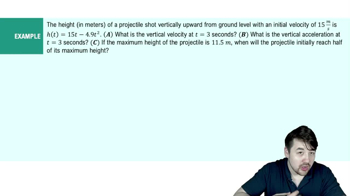
Derivatives Applied To Acceleration Example 2

Distance Formula

The distance formula is used to determine the distance between two points in a plane. It is derived from the Pythagorean theorem and is given by s = √((x2 - x1)² + (y2 - y1)²). In this context, it helps calculate the distance from the basketball to the hoop by considering the horizontal and vertical displacements.
추천 영상:
5:04
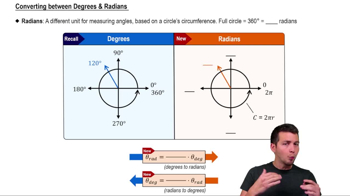
Converting between Degrees & Radians

Trigonometric Functions

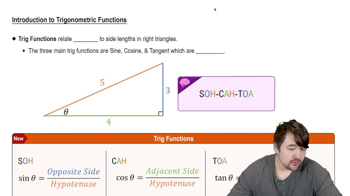
Trigonometric functions relate the angles of a triangle to the lengths of its sides. In projectile motion, they are used to resolve the initial velocity into horizontal and vertical components. For a launch angle of 45°, these components are equal, simplifying calculations of the basketball's path and its position at any point in time.
추천 영상:
가이드 코스
6:04
Introduction to Trigonometric Functions
관련 실천
교과서 질문

107–110. {Use of Tech} Motion with gravity Consider the following descriptions of the vertical motion of an object subject only to the acceleration due to gravity. Begin with the acceleration equation a(t) = v' (t) = -g , where g = 9.8 m/s² .

b. Find the position of the object for all relevant times. 

A payload is released at an elevation of 400 m from a hot-air balloon that is rising at a rate of 10 m/s.

43
views
교과서 질문

{Use of Tech} A damped oscillator The displacement of an object as it bounces vertically up and down on a spring is given by y(t) = 2.5e⁻ᵗ cos 2t, where the initial displacement is y(0) = 2.5 and y = 0 corresponds to the rest position (see figure). <IMAGE>

b. Find the time and the displacement when the object reaches its lowest point.

235
views
교과서 질문

Cylinder in a cone A right circular cylinder is placed inside a cone of radius R and height H so that the base of the cylinder lies on the base of the cone.


b. Find the dimensions of the cylinder with maximum lateral surface area (area of the curved surface).

389
views
교과서 질문

{Use of Tech} Fixed points of quadratics and quartics Let f(x) = ax(1 -x), where a is a real number and 0 ≤ a ≤ 1. Recall that the fixed point of a function is a value of x such that f(x) = x (Exercises 48–51). 


b. Consider the polynomial g(x) = f(f(x)). Write g in terms of a and powers of x. What is its degree?

341
views
교과서 질문

{Use of Tech} Every second counts You must get from a point P on the straight shore of a lake to a stranded swimmer who is 50 from a point Q on the shore that is 50 m from you (see figure). Assuming that you can swim at a speed of 2 m/s and run at a speed of 4 m/s, the goal of this exercise is to determine the point along the shore, x meters from Q, where you should stop running and start swimming to reach the swimmer in the minimum time. <IMAGE>


b. Find the critical point of T on (0, 50).

170
views
교과서 질문

{Use of Tech} Let f(x) = ln((x+1)/(x-1)) and g(x) = ln ((x+1)/(x-1)).

b. Sketch graphs of f and g to show that these functions do not differ by a constant.

264
views