Ch. 4 - Applications of the Derivative
Briggs - Calculus: Early Transcendentals 3rd Edition
Briggs3rd EditionCalculus: Early TranscendentalsISBN: 9780136847243당신이 사용하는 게 아니라요?교과서 변경
4장, 문제 4.8.21

{Use of Tech} Finding all roots Use Newton’s method to find all the roots of the following functions. Use preliminary analysis and graphing to determine good initial approximations.


f(x) = cos 2x - x² + 2x

검증된 단계별 안내
1
Step 1: Understand Newton's Method. Newton's method is an iterative numerical technique used to find approximate roots of a real-valued function. The formula for Newton's method is: x_{n+1} = x_n - \(\frac{f(x_n)}{f'(x_n)}\).
Step 2: Perform a preliminary analysis of the function f(x) = cos(2x) - x^2 + 2x. Analyze the behavior of the function by considering its components: cos(2x), -x^2, and 2x. Consider the range and periodicity of cos(2x) and the parabolic nature of -x^2 + 2x.
Step 3: Graph the function f(x) = cos(2x) - x^2 + 2x to visually identify potential roots. Look for points where the graph crosses the x-axis, as these are the approximate locations of the roots.
Step 4: Choose initial approximations for the roots based on the graph. These initial guesses should be close to where the graph crosses the x-axis. For example, if the graph suggests roots near x = a and x = b, use these as starting points.
Step 5: Apply Newton's method iteratively for each initial approximation. Calculate the derivative f'(x) = -2sin(2x) - 2x + 2. Use the formula x_{n+1} = x_n - \(\frac{f(x_n)}{f'(x_n)}\) to update the approximation until the change is sufficiently small, indicating convergence to a root.

비슷한 문제에 대한 검증된 영상 답변:

이 영상 해법은 위 문제에 도움이 된다고 튜터들이 추천한 것입니다.
영상 길이:
12m

주요 개념

질문에 올바르게 답하기 위해 반드시 이해해야 하는 핵심 개념들은 다음과 같습니다.

Newton's Method

Newton's Method is an iterative numerical technique used to find approximate roots of a real-valued function. It starts with an initial guess and refines it using the formula x_{n+1} = x_n - f(x_n)/f'(x_n), where f' is the derivative of f. This method converges quickly if the initial guess is close to the actual root, making it effective for functions that are differentiable.
추천 영상:
가이드 코스
4:26
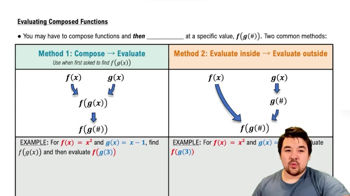
Evaluating Composed Functions

Preliminary Analysis

Preliminary analysis involves examining the function's behavior to identify potential roots before applying numerical methods. This can include evaluating the function at various points, analyzing its continuity, and determining intervals where the function changes sign, which indicates the presence of roots according to the Intermediate Value Theorem.
추천 영상:
가이드 코스
06:29
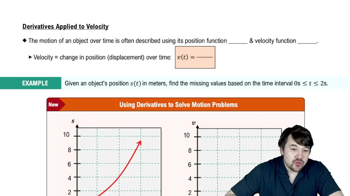
Derivatives Applied To Velocity

Graphing Functions

Graphing functions provides a visual representation of their behavior, helping to identify roots, intercepts, and critical points. By plotting the function, one can observe where it crosses the x-axis, indicating the roots, and assess the function's overall shape, which aids in selecting appropriate initial approximations for methods like Newton's.
추천 영상:
가이드 코스
5:53
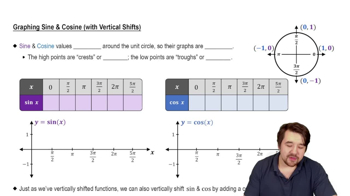
Graph of Sine and Cosine Function