
Ch. 4 - Applications of the Derivative
Briggs - Calculus: Early Transcendentals 3rd Edition
Briggs3rd EditionCalculus: Early TranscendentalsISBN: 9780136847243당신이 사용하는 게 아니라요?교과서 변경
4장, 문제 4.8.58d

{Use of Tech} Fixed points of quadratics and quartics Let f(x) = ax(1 -x), where a is a real number and 0 ≤ a ≤ 1. Recall that the fixed point of a function is a value of x such that f(x) = x (Exercises 48–51). 


d. Find the number and location of the fixed points of g for a = 2, 3, and 4 on the interval 0 ≤ x ≤ 1. 

검증된 단계별 안내
1
Understand the concept of a fixed point: A fixed point of a function f(x) is a value x such that f(x) = x. This means that when you substitute x into the function, the output is the same as the input.
Set up the equation for fixed points: For the function f(x) = ax(1 - x), we need to solve the equation ax(1 - x) = x to find the fixed points.
Rearrange the equation: Start by expanding the left side to get ax - ax^2 = x. Then, move all terms to one side to form a quadratic equation: ax - ax^2 - x = 0.
Factor the quadratic equation: Factor the equation ax - ax^2 - x = 0 to find the values of x. This can be done by factoring out x, giving x(a - ax - 1) = 0.
Solve for x: The factored equation x(a - ax - 1) = 0 gives two potential solutions: x = 0 and a - ax - 1 = 0. Solve the second equation for x to find the other fixed points, and analyze these solutions for different values of a (2, 3, and 4) within the interval 0 ≤ x ≤ 1.

비슷한 문제에 대한 검증된 영상 답변:

이 영상 해법은 위 문제에 도움이 된다고 튜터들이 추천한 것입니다.
영상 길이:
6m

주요 개념

질문에 올바르게 답하기 위해 반드시 이해해야 하는 핵심 개념들은 다음과 같습니다.

Fixed Points

A fixed point of a function f(x) is a value x such that f(x) = x. This means that when the function is applied to this value, it returns the same value. Finding fixed points often involves solving the equation f(x) - x = 0. In the context of the given function, identifying fixed points helps understand the behavior of the function within a specified interval.
추천 영상:
04:50
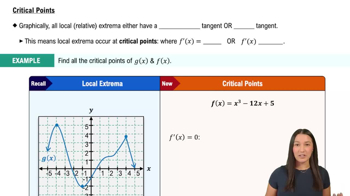
Critical Points

Quadratic and Quartic Functions

Quadratic functions are polynomial functions of degree two, typically expressed in the form f(x) = ax^2 + bx + c. Quartic functions are of degree four, represented as f(x) = ax^4 + bx^3 + cx^2 + dx + e. The behavior of these functions, including their fixed points, can be analyzed using their graphs, derivatives, and algebraic properties, which are essential for solving the problem at hand.
추천 영상:
6:04
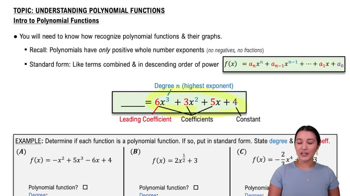
Introduction to Polynomial Functions

Interval Analysis

Interval analysis involves examining the behavior of functions within a specific range, in this case, 0 ≤ x ≤ 1. This is crucial for determining the existence and location of fixed points, as the function's behavior may vary significantly outside this interval. By restricting the analysis to a defined interval, one can apply techniques such as the Intermediate Value Theorem to ascertain the number of fixed points.
추천 영상:
가이드 코스
06:29
Derivatives Applied To Velocity
관련 실천
교과서 질문

107–110. {Use of Tech} Motion with gravity Consider the following descriptions of the vertical motion of an object subject only to the acceleration due to gravity. Begin with the acceleration equation a(t) = v' (t) = -g , where g = 9.8 m/s² .

d. Find the time when the object strikes the ground.

A payload is released at an elevation of 400 m from a hot-air balloon that is rising at a rate of 10 m/s.

56
views
교과서 질문

Interpreting the derivative The graph of f' on the interval [-3,2] is shown in the figure. <IMAGE>


f. Sketch one possible graph of f.

275
views
교과서 질문

Rectangles in triangles Find the dimensions and area of the rectangle of maximum area that can be inscribed in the following figures.

d. An arbitrary triangle with a given area A (The result applies to any triangle, but first consider triangles for which all the angles are less than or equal to 90° .)

373
views
교과서 질문

Sketch a graph of a function f with the following properties.


f' < 0 and f" < 0, for 8 < x < 10

264
views
교과서 질문

{Use of Tech} A damped oscillator The displacement of an object as it bounces vertically up and down on a spring is given by y(t) = 2.5e⁻ᵗ cos 2t, where the initial displacement is y(0) = 2.5 and y = 0 corresponds to the rest position (see figure). <IMAGE>


d. Find the time and the displacement when the object reaches its high point for the second time.

210
views
교과서 질문

Let ƒ(x) = (x - 3) (x + 3)²


g. Use your work in parts (a) through (f) to sketch a graph of ƒ.

253
views