Ch. 4 - Applications of the Derivative
Briggs - Calculus: Early Transcendentals 3rd Edition
Briggs3rd EditionCalculus: Early TranscendentalsISBN: 9780136847243당신이 사용하는 게 아니라요?교과서 변경
4장, 문제 4.8.43

{Use of Tech} Newton’s method and curve sketching Use Newton’s method to find approximate answers to the following questions.
Where is the first local minimum of f(x) = (cos x)/x on the interval (0,∞) located?

검증된 단계별 안내
1
Step 1: Understand Newton's Method. Newton's method is an iterative numerical technique used to find approximate roots of a real-valued function. The formula for Newton's method is: xn+1=xn-f(xn)f'(xn).
Step 2: Find the derivative of the function f(x) = (cos x)/x. Use the quotient rule for derivatives, which states: (uv)'=u'v-uv'v2, where u = cos x and v = x.
Step 3: Apply the quotient rule to find f'(x). Calculate u' = -sin x and v' = 1, then substitute into the quotient rule formula: f'(x)=(-sinx)x-cosx(1)x2.
Step 4: Choose an initial guess x₀ for the location of the first local minimum. Since the function is defined on the interval (0,∞), a reasonable starting point might be slightly greater than 0, such as x₀ = 0.1.
Step 5: Implement Newton's method iteratively using the formula from Step 1. Substitute f(x) and f'(x) into the formula, and update xₙ until the change between iterations is sufficiently small, indicating convergence to the local minimum.

비슷한 문제에 대한 검증된 영상 답변:

이 영상 해법은 위 문제에 도움이 된다고 튜터들이 추천한 것입니다.
영상 길이:
8m
도움이 되었나요?

주요 개념

질문에 올바르게 답하기 위해 반드시 이해해야 하는 핵심 개념들은 다음과 같습니다.

Newton's Method

Newton's Method is an iterative numerical technique used to find approximate solutions to equations. It starts with an initial guess and refines it using the formula x_{n+1} = x_n - f(x_n)/f'(x_n), where f is the function and f' is its derivative. This method is particularly useful for finding roots of functions, and it converges quickly under suitable conditions.
추천 영상:
가이드 코스
4:26
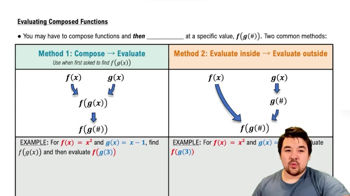
Evaluating Composed Functions

Local Minimum

A local minimum of a function is a point where the function value is lower than that of its immediate neighbors. Mathematically, this occurs where the first derivative of the function is zero (f'(x) = 0) and the second derivative is positive (f''(x) > 0). Identifying local minima is crucial in optimization problems and helps in understanding the behavior of functions.
추천 영상:
06:02
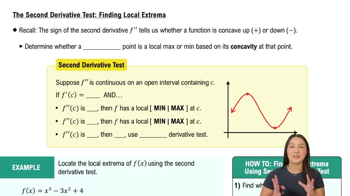
The Second Derivative Test: Finding Local Extrema

Curve Sketching

Curve sketching involves analyzing a function's behavior to create a visual representation of its graph. This includes determining key features such as intercepts, asymptotes, intervals of increase and decrease, and local extrema. By studying the first and second derivatives, one can gain insights into the function's shape and critical points, aiding in the overall understanding of its properties.
추천 영상:
11:41
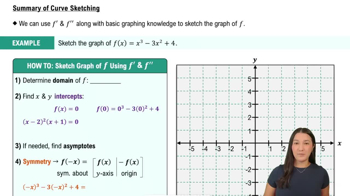
Summary of Curve Sketching