Ch. 4 - Applications of the Derivative
Briggs - Calculus: Early Transcendentals 3rd Edition
Briggs3rd EditionCalculus: Early TranscendentalsISBN: 9780136847243당신이 사용하는 게 아니라요?교과서 변경
4장, 문제 4.9.95

Velocity to position Given the following velocity functions of an object moving along a line, find the position function with the given initial position.


v(t) = 6t² + 4t - 10; s(0) = 0

검증된 단계별 안내
1
Step 1: Understand the problem. The velocity function v(t) = 6t² + 4t - 10 represents the rate of change of the position function s(t). To find the position function, we need to integrate the velocity function with respect to time t.
Step 2: Set up the integral. The position function s(t) is obtained by integrating v(t): s(t) = ∫(6t² + 4t - 10) dt.
Step 3: Perform the integration term by term. Use the power rule for integration: ∫tⁿ dt = (tⁿ⁺¹)/(n+1), and for constants, ∫C dt = Ct. Applying this to each term: ∫6t² dt = 2t³, ∫4t dt = 2t², and ∫-10 dt = -10t.
Step 4: Combine the results of the integration. The position function becomes s(t) = 2t³ + 2t² - 10t + C, where C is the constant of integration.
Step 5: Use the initial condition s(0) = 0 to solve for C. Substitute t = 0 into s(t): s(0) = 2(0)³ + 2(0)² - 10(0) + C = 0. This simplifies to C = 0. Therefore, the position function is s(t) = 2t³ + 2t² - 10t.

비슷한 문제에 대한 검증된 영상 답변:

이 영상 해법은 위 문제에 도움이 된다고 튜터들이 추천한 것입니다.
영상 길이:
2m

주요 개념

질문에 올바르게 답하기 위해 반드시 이해해야 하는 핵심 개념들은 다음과 같습니다.

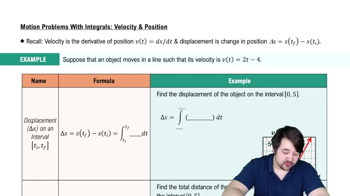
Velocity and Position Functions

Velocity is the rate of change of position with respect to time, represented mathematically as the derivative of the position function. To find the position function from a given velocity function, one must integrate the velocity function. This process reverses differentiation, allowing us to recover the original position function from its rate of change.
추천 영상:
가이드 코스
10:17
Using The Velocity Function

Integration

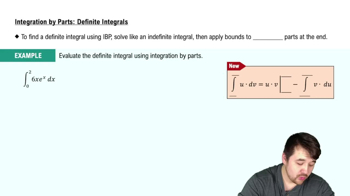
Integration is a fundamental concept in calculus that involves finding the antiderivative of a function. In this context, integrating the velocity function v(t) = 6t² + 4t - 10 will yield the position function s(t). The result of integration includes a constant of integration, which can be determined using initial conditions, such as the initial position s(0) = 0.
추천 영상:
가이드 코스
06:18
Integration by Parts for Definite Integrals

Initial Conditions

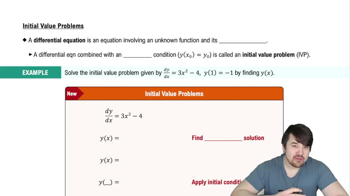
Initial conditions are specific values that help determine the constants of integration when solving differential equations. In this problem, the initial position s(0) = 0 provides a boundary condition that allows us to solve for the constant after integrating the velocity function. This ensures that the position function accurately reflects the object's position at the start of the observation.
추천 영상:
가이드 코스
05:03
Initial Value Problems