Ch. 5 - Integration
Briggs - Calculus: Early Transcendentals 3rd Edition
Briggs3rd EditionCalculus: Early TranscendentalsISBN: 9780136847243당신이 사용하는 게 아니라요?교과서 변경
5장, 문제 5.3.17b

Area functions for the same linear function Let ƒ(t) = t and consider the two area functions A(𝓍) = ∫₀ˣ ƒ(t) dt and F(𝓍) = ∫₂ˣ ƒ(t) dt .
(b) Evaluate F(4) and F(6). Then use geometry to find an expression for F (𝓍) , for 𝓍 ≥ 2. 

검증된 단계별 안내
1
Step 1: Understand the problem. We are given a linear function ƒ(t) = t and two area functions: A(𝓍) = ∫₀ˣ ƒ(t) dt and F(𝓍) = ∫₂ˣ ƒ(t) dt. The goal is to evaluate F(4) and F(6), and then derive a general expression for F(𝓍) using geometry for 𝓍 ≥ 2.
Step 2: Recall the geometric interpretation of definite integrals. The integral ∫₂ˣ ƒ(t) dt represents the area under the curve ƒ(t) = t from t = 2 to t = 𝓍. Since ƒ(t) = t is a linear function, the graph is a straight line, and the area can be calculated as the area of a trapezoid or triangle.
Step 3: Evaluate F(4). To find F(4), compute the definite integral ∫₂⁴ t dt. This represents the area under the line ƒ(t) = t from t = 2 to t = 4. Use the formula for the definite integral of t, ∫ t dt = (1/2)t², and evaluate it at the bounds 2 and 4.
Step 4: Evaluate F(6). Similarly, compute the definite integral ∫₂⁶ t dt. This represents the area under the line ƒ(t) = t from t = 2 to t = 6. Again, use the formula for the definite integral of t, ∫ t dt = (1/2)t², and evaluate it at the bounds 2 and 6.
Step 5: Derive a general expression for F(𝓍) for 𝓍 ≥ 2. Using geometry, note that the area under the line ƒ(t) = t from t = 2 to t = 𝓍 forms a trapezoid or triangle. The formula for the area of a trapezoid is (1/2)(base1 + base2) × height. Alternatively, use the definite integral formula ∫₂ˣ t dt = (1/2)𝓍² - (1/2)(2²) to express F(𝓍).

비슷한 문제에 대한 검증된 영상 답변:

이 영상 해법은 위 문제에 도움이 된다고 튜터들이 추천한 것입니다.
영상 길이:
2m
도움이 되었나요?

주요 개념

질문에 올바르게 답하기 위해 반드시 이해해야 하는 핵심 개념들은 다음과 같습니다.

Definite Integral

A definite integral represents the signed area under a curve defined by a function over a specific interval. In this context, the area functions A(x) and F(x) are calculated using the definite integral of the function f(t) = t from a lower limit to an upper limit. Understanding how to evaluate definite integrals is crucial for finding the values of F(4) and F(6).
추천 영상:
가이드 코스
05:43
Definition of the Definite Integral

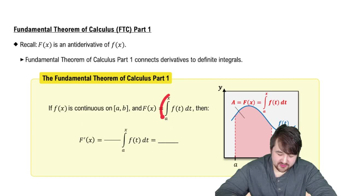
Fundamental Theorem of Calculus

The Fundamental Theorem of Calculus links the concept of differentiation with integration, stating that if F is an antiderivative of f on an interval, then the integral of f from a to b is equal to F(b) - F(a). This theorem is essential for evaluating the area functions A(x) and F(x) and helps in deriving expressions for these functions based on their limits.
추천 영상:
가이드 코스
06:11
Fundamental Theorem of Calculus Part 1

Geometric Interpretation of Integrals

The geometric interpretation of integrals involves visualizing the area under a curve as a physical space that can be calculated. In this problem, using geometry to find an expression for F(x) for x ≥ 2 means recognizing the shape formed by the linear function f(t) = t and calculating the area of the resulting geometric figure, such as a triangle or trapezoid, to derive a formula for F(x).
추천 영상:
04:18
Geometric Sequences - Recursive Formula