Ch. 5 - Integration
Briggs - Calculus: Early Transcendentals 3rd Edition
Briggs3rd EditionCalculus: Early TranscendentalsISBN: 9780136847243당신이 사용하는 게 아니라요?교과서 변경
5장, 문제 5.R.105f

Consider the function
ƒ(t) = { t      if  ―2 ≤ t < 0
t²/2    if    0 ≤ t ≤ 2                                                                                                                                                                       
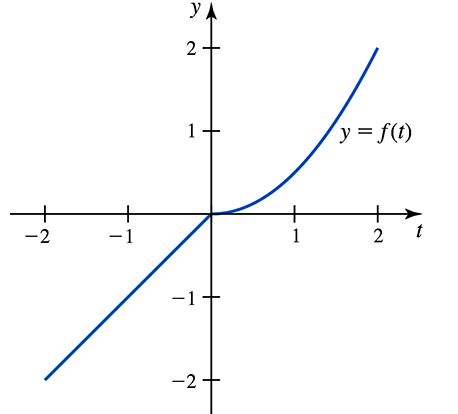
and its graph shown below. Let F(𝓍) = ∫₋₁ˣ ƒ(t) dt and G(𝓍) = ∫₋₂ˣ ƒ(t) dt.

(f) Find a constant C such that F(𝓍) = G(𝓍) + C .

검증된 단계별 안내
1
Step 1: Understand the problem. We are tasked with finding a constant C such that F(𝓍) = G(𝓍) + C, where F(𝓍) = ∫₋₁ˣ ƒ(t) dt and G(𝓍) = ∫₋₂ˣ ƒ(t) dt. This involves comparing the two integrals and determining the relationship between them.
Step 2: Analyze the difference between the limits of integration for F(𝓍) and G(𝓍). Note that the lower limit of integration for F(𝓍) is -1, while for G(𝓍) it is -2. This means that G(𝓍) includes an additional integral from t = -2 to t = -1 compared to F(𝓍).
Step 3: Compute the integral of ƒ(t) from t = -2 to t = -1. From the graph and the piecewise definition of ƒ(t), ƒ(t) = t for -2 ≤ t < 0. Therefore, the integral from -2 to -1 is ∫₋₂⁻¹ t dt. Use the formula for the integral of t: ∫ t dt = t²/2.
Step 4: Evaluate the definite integral ∫₋₂⁻¹ t dt. Substitute the limits of integration into the formula t²/2: [(-1)²/2 - (-2)²/2]. This calculation gives the constant value that represents the difference between F(𝓍) and G(𝓍).
Step 5: Conclude that the constant C is equal to the value of the integral from t = -2 to t = -1. Thus, F(𝓍) = G(𝓍) + C, where C is the result of the definite integral computed in Step 4.

비슷한 문제에 대한 검증된 영상 답변:

이 영상 해법은 위 문제에 도움이 된다고 튜터들이 추천한 것입니다.
영상 길이:
5m
도움이 되었나요?

주요 개념

질문에 올바르게 답하기 위해 반드시 이해해야 하는 핵심 개념들은 다음과 같습니다.

Piecewise Functions

A piecewise function is defined by different expressions based on the input value. In this case, the function ƒ(t) has two distinct definitions: one for t in the interval [−2, 0) and another for t in the interval [0, 2]. Understanding how to evaluate piecewise functions is crucial for analyzing their behavior across different intervals.
추천 영상:
가이드 코스
05:36
Piecewise Functions

Definite Integrals

Definite integrals calculate the area under a curve between two specified limits. In the question, F(x) and G(x) are defined as integrals of the function ƒ(t) over different intervals. Grasping the concept of definite integrals is essential for determining the relationship between F(x) and G(x) and finding the constant C.
추천 영상:
가이드 코스
05:43
Definition of the Definite Integral

Fundamental Theorem of Calculus

The Fundamental Theorem of Calculus links differentiation and integration, stating that if F is an antiderivative of f on an interval, then the integral of f from a to b is F(b) - F(a). This theorem is vital for solving the problem, as it allows us to relate the integrals F(x) and G(x) to their respective areas under the curve of ƒ(t) and find the constant C.
추천 영상:
가이드 코스
06:11
Fundamental Theorem of Calculus Part 1
관련 실천
교과서 질문

Evaluate the following derivatives.


d/d𝓍 ∫₃ᵉˣ cos t² dt

98
views

교과서 질문

Evaluating integrals Evaluate the following integrals.                                                                                                                                         


 ∫ sin 𝒵 sin (cos 𝒵) d𝒵

56
views
교과서 질문

Evaluating integrals Evaluate the following integrals.


∫₁⁴ ((√v + v) / v ) dv

70
views
교과서 질문

Change of variables Use the change of variables u³ = 𝓍² ― 1 to evaluate the integral ∫₁³ 𝓍∛(𝓍²―1) d𝓍 .

165
views
교과서 질문

Area functions and the Fundamental Theorem Consider the function

ƒ(t) = { t      if  ―2 ≤ t < 0

t²/2    if    0 ≤ t ≤ 2

and its graph shown below. Let F(𝓍) = ∫₋₁ˣ ƒ(t) dt and G(𝓍) = ∫₋₂ˣ ƒ(t) dt.

(c) Use the Fundamental Theorem to find an expression for F '(𝓍) for 0 ≤ 𝓍 < 2.

57
views
교과서 질문

Evaluating integrals Evaluate the following integrals.


∫₋π/₂^π/² (cos 2𝓍 + cos 𝓍 sin 𝓍 ― 3 sin 𝓍⁵) d𝓍

71
views