Ch. 5 - Integration
Briggs - Calculus: Early Transcendentals 3rd Edition
Briggs3rd EditionCalculus: Early TranscendentalsISBN: 9780136847243당신이 사용하는 게 아니라요?교과서 변경
5장, 문제 5.2.43

Definite integrals Use geometry (not Riemann sums) to evaluate the following definite integrals. Sketch a graph of the integrand, show the region in question, and interpret your result.                                                                                                                                      
                                                                                                                                                                                       
 ∫₀⁴ √(16― 𝓍² ) d𝓍

검증된 단계별 안내
1
Recognize that the integral \(\int_0^4 \sqrt{16 - x^2} \, dx\) represents the area under the curve \(y = \sqrt{16 - x^2}\) from \(x=0\) to \(x=4\).
Note that the equation \(y = \sqrt{16 - x^2}\) describes the upper half of a circle centered at the origin with radius 4, since \(x^2 + y^2 = 16\).
Sketch the circle \(x^2 + y^2 = 16\) and shade the region from \(x=0\) to \(x=4\) under the upper semicircle to visualize the area represented by the integral.
Calculate the area of the quarter circle (since \(x\) goes from 0 to 4 and \(y\) is positive) using the formula for the area of a circle sector: \(\text{Area} = \frac{1}{4} \pi r^2\) where \(r=4\).
Conclude that the value of the definite integral equals the area of this quarter circle, which is \(\frac{1}{4} \pi \times 4^2\).

비슷한 문제에 대한 검증된 영상 답변:

이 영상 해법은 위 문제에 도움이 된다고 튜터들이 추천한 것입니다.
영상 길이:
3m
도움이 되었나요?

주요 개념

질문에 올바르게 답하기 위해 반드시 이해해야 하는 핵심 개념들은 다음과 같습니다.

Definite Integral as Area Under a Curve

A definite integral represents the net area between the graph of a function and the x-axis over a specified interval. When the function is non-negative, this corresponds to the geometric area under the curve. Understanding this allows one to interpret integrals as areas, which can be calculated using geometric formulas instead of limits or sums.
추천 영상:
05:43
Definition of the Definite Integral

Geometry of a Circle and Its Equation

The integrand √(16 - x²) describes the upper half of a circle centered at the origin with radius 4, since x² + y² = 16 is the equation of a circle. Recognizing this helps in visualizing the region under the curve as a semicircle, enabling the use of geometric area formulas to evaluate the integral.
추천 영상:
가이드 코스
06:03
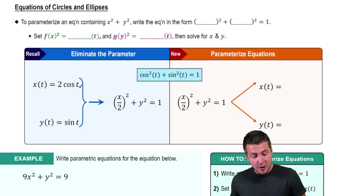
Parameterizing Equations of Circles & Ellipses

Using Geometric Formulas to Evaluate Integrals

Instead of computing the integral via Riemann sums or antiderivatives, one can use known geometric area formulas, such as the area of a semicircle (½πr²), to find the value of the integral. This approach simplifies the problem by connecting calculus with classical geometry.
추천 영상:
가이드 코스
04:18
Geometric Sequences - Recursive Formula
관련 실천
교과서 질문

Variations on the substitution method Evaluate the following integrals.                                                                                                        


 ∫ 𝓍/(√𝓍―4) d𝓍

67
views
교과서 질문

Variations on the substitution method Evaluate the following integrals.                                                                                                        


 ∫ 𝓍/(∛𝓍 + 4) d𝓍

54
views
교과서 질문

Evaluate ∫₃⁸ ƒ ′(t) dt , where ƒ ′ is continuous on [3, 8], ƒ(3) = 4, and ƒ(8) = 20 .

37
views
교과서 질문

Definite integrals Evaluate the following integrals using the Fundamental Theorem of Calculus


∫₁⁹ 2/(√𝓍) d𝓍

106
views
교과서 질문

When using a change of variables u = g(𝓍) to evaluate the definite integral ∫ₐᵇ ƒ(g(𝓍)) g' (𝓍) d(𝓍), how are the limits of integration transformed?

66
views
교과서 질문

Definite integrals Use a change of variables or Table 5.6 to evaluate the following definite integrals.                                                                                                                         


 ∫₁/₃^¹/√³ 4/(9𝓍² + 1) d𝓍

102
views