Ch. 5 - Integration
Briggs - Calculus: Early Transcendentals 3rd Edition
Briggs3rd EditionCalculus: Early TranscendentalsISBN: 9780136847243당신이 사용하는 게 아니라요?교과서 변경
5장, 문제 5.R.50

Evaluating integrals Evaluate the following integrals.


∫₁ᵉ d𝓍 / [𝓍(1 + ln 𝓍)]

검증된 단계별 안내
1
Step 1: Recognize that the integral ∫₁ᵉ d𝓍 / [𝓍(1 + ln 𝓍)] involves a logarithmic function in the denominator, suggesting a substitution method might simplify the problem. Let u = ln(𝓍), which implies that du = d𝓍 / 𝓍.
Step 2: Substitute u = ln(𝓍) into the integral. When 𝓍 = 1, u = ln(1) = 0, and when 𝓍 = e, u = ln(e) = 1. The integral now becomes ∫₀¹ du / (1 + u).
Step 3: Recognize that the integral ∫₀¹ du / (1 + u) is a standard form that can be solved using the natural logarithm function. Specifically, the integral of 1 / (1 + u) is ln|1 + u|.
Step 4: Apply the antiderivative formula to evaluate the integral. The result is ln|1 + u| evaluated from u = 0 to u = 1.
Step 5: Substitute the limits of integration into the antiderivative expression ln|1 + u| to complete the evaluation. Simplify the result to express the final answer.

비슷한 문제에 대한 검증된 영상 답변:

이 영상 해법은 위 문제에 도움이 된다고 튜터들이 추천한 것입니다.
영상 길이:
2m
도움이 되었나요?

주요 개념

질문에 올바르게 답하기 위해 반드시 이해해야 하는 핵심 개념들은 다음과 같습니다.

Integration

Integration is a fundamental concept in calculus that involves finding the accumulated area under a curve represented by a function. It is the reverse process of differentiation and can be used to calculate quantities such as areas, volumes, and total accumulated change. The integral symbol (∫) denotes the operation, and definite integrals have specified limits, while indefinite integrals do not.
추천 영상:
06:18
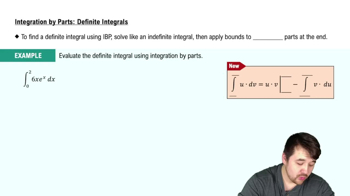
Integration by Parts for Definite Integrals

Natural Logarithm

The natural logarithm, denoted as ln(x), is the logarithm to the base e, where e is approximately 2.71828. It is a crucial function in calculus, particularly in integration and differentiation, as it arises in various contexts, including growth processes and compound interest. Understanding its properties, such as ln(ab) = ln(a) + ln(b), is essential for manipulating expressions involving logarithms.
추천 영상:
05:18
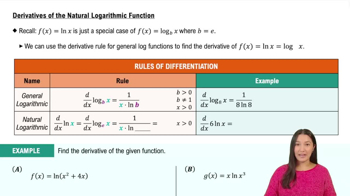
Derivative of the Natural Logarithmic Function

Substitution Method

The substitution method is a technique used in integration to simplify the process by changing the variable of integration. By substituting a part of the integrand with a new variable, the integral can often be transformed into a more manageable form. This method is particularly useful when dealing with composite functions or when the integrand contains a function and its derivative.
추천 영상:
07:33
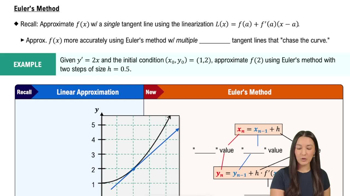
Euler's Method
관련 실천
교과서 질문

Area functions and the Fundamental Theorem Consider the function

ƒ(t) = { t      if  ―2 ≤ t < 0

t²/2    if    0 ≤ t ≤ 2

and its graph shown below. Let F(𝓍) = ∫₋₁ˣ ƒ(t) dt and G(𝓍) = ∫₋₂ˣ ƒ(t) dt.                                                                                                               


(a) Evaluate F(―2) and F(2).

94
views
교과서 질문

Evaluating integrals Evaluate the following integrals.


∫₁⁴ ((√v + v) / v ) dv

70
views
교과서 질문

Consider the function

ƒ(t) = { t      if  ―2 ≤ t < 0

t²/2    if    0 ≤ t ≤ 2                                                                                                                                                                       

and its graph shown below. Let F(𝓍) = ∫₋₁ˣ ƒ(t) dt and G(𝓍) = ∫₋₂ˣ ƒ(t) dt.

(f) Find a constant C such that F(𝓍) = G(𝓍) + C .

48
views
교과서 질문

Evaluating integrals Evaluate the following integrals.


∫₀² (2𝓍 + 1)³ d𝓍

109
views
교과서 질문

Integration by Riemann sums Consider the integral ∫₁⁴ (3𝓍― 2) d𝓍.


(a) Evaluate the right Riemann sum for the integral with n = 3 .

85
views
교과서 질문

Evaluating integrals Evaluate the following integrals.                                                                                                                                         


 ∫ d𝓍/[(tan⁻¹ 𝓍) (1 + 𝓍²)]

63
views