Ch. 5 - Integration
Briggs - Calculus: Early Transcendentals 3rd Edition
Briggs3rd EditionCalculus: Early TranscendentalsISBN: 9780136847243당신이 사용하는 게 아니라요?교과서 변경
5장, 문제 5.5.106

General results Evaluate the following integrals in which the function ƒ is unspecified. Note that ƒ⁽ᵖ⁾ is the pth derivative of ƒ and ƒᵖ is the pth power of ƒ. Assume ƒ and its derivatives are continuous for all real numbers. 
∫ (5 ƒ³ (𝓍) + 7ƒ² (𝓍) + ƒ (𝓍 )) ƒ'(𝓍) d𝓍

검증된 단계별 안내
1
Recognize that the integral is of the form \( \int (5 f^3(x) + 7 f^2(x) + f(x)) f'(x) \, dx \), where \( f(x) \) is an unspecified function and \( f'(x) \) is its derivative.
Use the substitution method by letting \( u = f(x) \). Then, the differential \( du = f'(x) \, dx \). This transforms the integral into \( \int (5 u^3 + 7 u^2 + u) \, du \).
Rewrite the integral in terms of \( u \): \( \int (5 u^3 + 7 u^2 + u) \, du = \int 5 u^3 \, du + \int 7 u^2 \, du + \int u \, du \).
Integrate each term separately using the power rule for integration: \( \int u^n \, du = \frac{u^{n+1}}{n+1} + C \). So, compute \( \int 5 u^3 \, du \), \( \int 7 u^2 \, du \), and \( \int u \, du \) accordingly.
After integrating, substitute back \( u = f(x) \) to express the result in terms of \( f(x) \). Don't forget to add the constant of integration \( + C \).

비슷한 문제에 대한 검증된 영상 답변:

이 영상 해법은 위 문제에 도움이 된다고 튜터들이 추천한 것입니다.
영상 길이:
2m
도움이 되었나요?

주요 개념

질문에 올바르게 답하기 위해 반드시 이해해야 하는 핵심 개념들은 다음과 같습니다.

Integration by Substitution

Integration by substitution is a method used to simplify integrals by changing variables. When an integral contains a function and its derivative, substituting the inner function with a new variable can transform the integral into a basic form, making it easier to evaluate.
추천 영상:
04:27
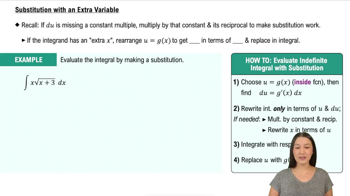
Substitution With an Extra Variable

Notation and Interpretation of Derivatives and Powers

Understanding the notation is crucial: ƒ⁽ᵖ⁾ denotes the pth derivative of ƒ, while ƒᵖ means the pth power of ƒ. Distinguishing between these helps correctly interpret the integrand and apply appropriate integration techniques.
추천 영상:
05:58
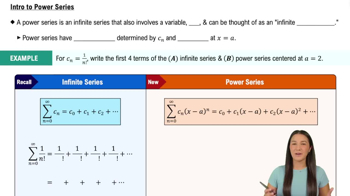
Intro to Power Series

Properties of Continuous Functions and Their Derivatives

Assuming ƒ and its derivatives are continuous ensures the validity of applying substitution and other integration rules. Continuity guarantees no abrupt changes, allowing the integral to be evaluated smoothly over the real numbers.
추천 영상:
가이드 코스
06:21
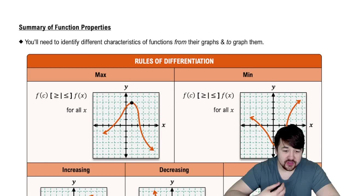
Properties of Functions
관련 실천
교과서 질문

Indefinite integrals Use a change of variables or Table 5.6 to evaluate the following indefinite integrals. Check your work by differentiating.                                                                                  


 ∫ sec 4w tan 4w dw

55
views

교과서 질문

Derivatives of integrals Simplify the following expressions.


d/dt ∫₀ᵗ d𝓍/(1 + 𝓍²) + ∫₁¹/ᵗ dx/(1 + 𝓍²)

126
views
교과서 질문

Definite integrals from graphs The figure shows the areas of regions bounded by the graph of ƒ and the 𝓍-axis. Evaluate the following integrals.


∫₀ᵃ ƒ(𝓍) d𝓍

57
views
교과서 질문

Average value of the derivative Suppose ƒ ' is a continuous function for all real numbers. Show that the average value of the derivative on an interval [a, b] is ƒ⁻' = (ƒ(b) ―ƒ(a))/ (b―a) . Interpret this result in terms of secant lines.

128
views
교과서 질문

Indefinite integrals Use a change of variables or Table 5.6 to evaluate the following indefinite integrals. Check your work by differentiating.                                                                                  


 ∫ (sin⁵ 𝓍 + 3 sin³ 𝓍― sin 𝓍) cos 𝓍 d𝓍

74
views
교과서 질문

Use the given substitution to evaluate the following indefinite integrals. Check your answer by differentiating.                                                                                              


 ∫ (6𝓍 + 1) √(3𝓍² + 𝓍) d𝓍 , u = 3𝓍² + 𝓍

52
views