Ch. 5 - Integration
Briggs - Calculus: Early Transcendentals 3rd Edition
Briggs3rd EditionCalculus: Early TranscendentalsISBN: 9780136847243당신이 사용하는 게 아니라요?교과서 변경
5장, 문제 5.1.49e

Sigma notation Evaluate the following expressions.                                                                                                                                          
(e)     3                                                                                                                                                                               
       ∑  (2m + 2) / 3                                                                                                                                                                          
      m =1                         

검증된 단계별 안내
1
Step 1: Understand the problem. The given expression is a summation in sigma notation: ∑ (2m + 2) / 3, where m starts at 1 and goes up to a specified upper limit. Sigma notation represents the sum of terms generated by substituting values of m into the given formula.
Step 2: Identify the range of summation. The problem does not explicitly state the upper limit of m, so ensure you know the range of m values to evaluate the summation. For example, if the upper limit is n, the summation would be ∑ from m=1 to m=n.
Step 3: Break down the summation formula. The term (2m + 2) / 3 can be split into two separate terms: (2m / 3) + (2 / 3). This allows you to compute the summation of each part separately.
Step 4: Apply the summation rules. Use the linearity of summation: ∑ [(2m / 3) + (2 / 3)] = (2/3) ∑ m + (2/3) ∑ 1. Here, ∑ m represents the sum of integers from 1 to n, and ∑ 1 represents the sum of n ones.
Step 5: Compute the individual summations. For ∑ m, use the formula for the sum of the first n integers: ∑ m = n(n + 1) / 2. For ∑ 1, the result is simply n. Substitute these results back into the expression to simplify further.

비슷한 문제에 대한 검증된 영상 답변:

이 영상 해법은 위 문제에 도움이 된다고 튜터들이 추천한 것입니다.
영상 길이:
3m
도움이 되었나요?

주요 개념

질문에 올바르게 답하기 위해 반드시 이해해야 하는 핵심 개념들은 다음과 같습니다.

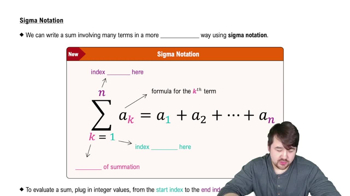
Sigma Notation

Sigma notation is a concise way to represent the sum of a sequence of terms. It uses the Greek letter sigma (Σ) to indicate summation, followed by an expression that defines the terms to be summed. The notation includes limits that specify the starting and ending indices of the summation, allowing for efficient representation of large sums.
추천 영상:

Arithmetic Expressions

Arithmetic expressions are mathematical phrases that combine numbers, variables, and operators (such as addition, subtraction, multiplication, and division) to represent a value. In the context of sigma notation, the expression inside the summation often involves variables and constants, which can be manipulated to simplify or evaluate the sum.
추천 영상:
5:17
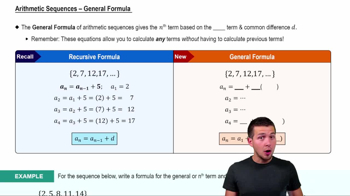
Arithmetic Sequences - General Formula

Evaluating Summations

Evaluating summations involves calculating the total value of a series of terms defined by a summation expression. This process may require substituting values for the variable, performing arithmetic operations, and applying algebraic techniques to simplify the expression before arriving at the final sum. Understanding how to manipulate and compute these expressions is crucial for solving problems involving sigma notation.
추천 영상:
5:14
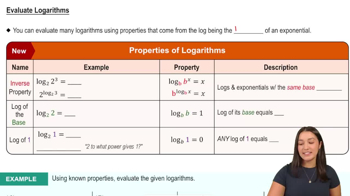
Evaluate Logarithms
관련 실천
교과서 질문

Use Table 5.6 to evaluate the following indefinite integrals.                                                                                                               


 (e) ∫ d𝓍/(81 + 9𝓍²) (Hint: Factor a 9 out of the denominator first.)  

57
views

교과서 질문

Left and right Riemann sums Complete the following steps for the given function, interval, and value of n.

{Use of Tech} ƒ(𝓍) = e ˣ/₂ on [1,4]; n = 6

(d) Calculate the left and right Riemann sums. 

119
views
교과서 질문

Sigma notation Evaluate the following expressions.                                                                                                                                          

  (f)      3                                                                                                                                                                               

       ∑ (3j ― 4)                                                                                                                                                                          

      j =1                         

83
views
교과서 질문

Properties of integrals Consider two functions ƒ and g on [1,6] such that ∫₁⁶ƒ(𝓍) d𝓍 = 10 and ∫₁⁶g(𝓍) d𝓍 = 5, ∫₄⁶ƒ(𝓍) d𝓍 = 5 , and ∫₁⁴g(𝓍) d𝓍 = 2. Evaluate the following integrals.


(f) ∫₄¹ 2f(𝓍) d𝓍

49
views
교과서 질문

Use Table 5.6 to evaluate the following indefinite integrals.                                                                                                               


 (f) ∫ d𝓍/√36 ―𝓍²

78
views
교과서 질문

Midpoint Riemann sums Complete the following steps for the given function, interval, and value of n.


ƒ(𝓍) = 1/x on [1,6] ; n = 5


(d) Calculate the midpoint Riemann sum.

235
views