
교과서 질문
Working with area functions Consider the function ƒ and its graph.
(c) Sketch a graph of A, for 0 ≤ 𝓍 ≤ 10 , without a scale on the y-axis.
64
views

 검증된 단계별 안내

 05:43
05:43
 06:11
06:11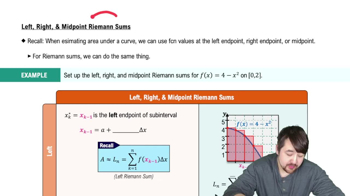 07:39
07:39Working with area functions Consider the function ƒ and its graph.
(c) Sketch a graph of A, for 0 ≤ 𝓍 ≤ 10 , without a scale on the y-axis.
Zero net area Consider the function ƒ(𝓍) = 𝓍² ― 4𝓍 .
c) In general, for the function ƒ(𝓍) = 𝓍² ― a𝓍, where a > 0, for what value of b > 0 (as a function of a) is ∫₀ᵇ ƒ(𝓍) d𝓍 = 0 ?
Use Table 5.6 to evaluate the following definite integrals.
(c) ∫₃√₂^⁶ d𝓍/(𝓍² ―9)
{Use of Tech} Approximating definite integrals Complete the following steps for the given integral and the given value of n.
(c) Calculate the left and right Riemann sums for the given value of n.
∫₁⁷ 1/𝓍 d𝓍 ; n = 6
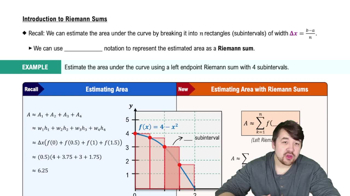
Approximating areas Estimate the area of the region bounded by the graph of ƒ(𝓍) = x² + 2 and the x-axis on [0, 2] in the following ways.
(c) Divide [0, 2] into n = 4 subintervals and approximate the area of the region using a right Riemann sum. Illustrate the solution geometrically.
{Use of Tech} Approximating definite integrals Complete the following steps for the given integral and the given value of n.
(c) Calculate the left and right Riemann sums for the given value of n.
∫₀^π/2 cos 𝓍 d𝓍 ; n = 4