Ch. 5 - Integration
5์žฅ, ๋ฌธ์ œ 5.R.96a

Velocity to displacement An object travels on the ๐“-axis with a velocity given by v(t) = 2t + 5, for 0 โ‰ค t โ‰ค 4.


(a) How far does the object travel, for 0 โ‰ค t โ‰ค 4 ?

๊ฒ€์ฆ๋œ ๋‹จ๊ณ„๋ณ„ ์•ˆ๋‚ด
1
Step 1: Recognize that the displacement of the object can be found by integrating the velocity function v(t) = 2t + 5 over the given time interval [0, 4]. The formula for displacement is: \( s(t) = \int v(t) \, dt \).
Step 2: Set up the definite integral for displacement: \( \int_{0}^{4} (2t + 5) \, dt \). This represents the total distance traveled by the object from t = 0 to t = 4.
Step 3: Break the integral into two parts for easier computation: \( \int_{0}^{4} 2t \, dt + \int_{0}^{4} 5 \, dt \).
Step 4: Compute each integral separately. For \( \int_{0}^{4} 2t \, dt \), use the power rule of integration: \( \int t^n \, dt = \frac{t^{n+1}}{n+1} \). For \( \int_{0}^{4} 5 \, dt \), treat 5 as a constant and multiply it by the length of the interval.
Step 5: Add the results of the two integrals together to find the total displacement. This will give the total distance traveled by the object over the interval [0, 4].

๋น„์Šทํ•œ ๋ฌธ์ œ์— ๋Œ€ํ•œ ๊ฒ€์ฆ๋œ ์˜์ƒ ๋‹ต๋ณ€:

์ด ์˜์ƒ ํ•ด๋ฒ•์€ ์œ„ ๋ฌธ์ œ์— ๋„์›€์ด ๋œ๋‹ค๊ณ  ํŠœํ„ฐ๋“ค์ด ์ถ”์ฒœํ•œ ๊ฒƒ์ž…๋‹ˆ๋‹ค.
์˜์ƒ ๊ธธ์ด:
2m
๋„์›€์ด ๋˜์—ˆ๋‚˜์š”?

์ฃผ์š” ๊ฐœ๋…

์งˆ๋ฌธ์— ์˜ฌ๋ฐ”๋ฅด๊ฒŒ ๋‹ตํ•˜๊ธฐ ์œ„ํ•ด ๋ฐ˜๋“œ์‹œ ์ดํ•ดํ•ด์•ผ ํ•˜๋Š” ํ•ต์‹ฌ ๊ฐœ๋…๋“ค์€ ๋‹ค์Œ๊ณผ ๊ฐ™์Šต๋‹ˆ๋‹ค.

Velocity

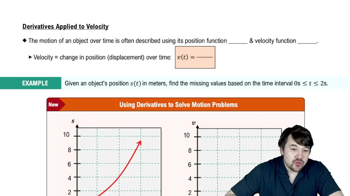
Velocity is the rate of change of an object's position with respect to time. In this context, the velocity function v(t) = 2t + 5 describes how the object's speed changes over time. Understanding velocity is crucial for determining how far the object travels over a given time interval.
์ถ”์ฒœ ์˜์ƒ:
๊ฐ€์ด๋“œ ์ฝ”์Šค
06:29
Derivatives Applied To Velocity

Displacement

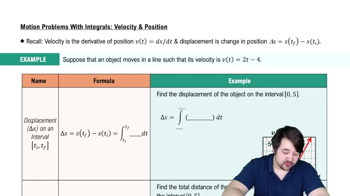
Displacement refers to the change in position of an object and can be calculated as the integral of the velocity function over a specific time interval. In this case, to find the total distance traveled by the object from t = 0 to t = 4, we need to integrate the velocity function v(t) over that interval.
์ถ”์ฒœ ์˜์ƒ:

Definite Integral

A definite integral calculates the accumulation of quantities, such as area under a curve, over a specified interval. In this problem, we will use the definite integral of the velocity function from t = 0 to t = 4 to find the total distance traveled by the object, which is essential for solving the question.
์ถ”์ฒœ ์˜์ƒ:
๊ฐ€์ด๋“œ ์ฝ”์Šค
05:43
Definition of the Definite Integral
๊ด€๋ จ ์‹ค์ฒœ
๊ต๊ณผ์„œ ์งˆ๋ฌธ

Area versus net area Find (i) the net area and (ii) the area of the region bounded by the graph of ฦ’ and the ๐“-axis on the given interval. You may find it useful to sketch the region.

ฦ’(๐“) = ๐“โด โ€• ๐“ยฒ on [โ€•1, 1]

152
views
๊ต๊ณผ์„œ ์งˆ๋ฌธ

Function defined by an integral Let H (๐“) = โˆซโ‚€หฃ โˆš(4 โ€• tยฒ) dt, for โ€• 2 โ‰ค ๐“ โ‰ค 2.

(a) Evaluate H (0) .

61
views
๊ต๊ณผ์„œ ์งˆ๋ฌธ

Area by geometry Use geometry to evaluate the following definite integrals, where the graph of ฦ’ is given in the figure.

(a) โˆซโ‚€โด ฦ’(๐“) d๐“

96
views
๊ต๊ณผ์„œ ์งˆ๋ฌธ

Evaluating integrals Evaluate the following integrals.


โˆซฯ€/โ‚โ‚‚^ฯ€/โน (csc 3๐“ cot 3๐“ + sec 3๐“ tan 3๐“) d๐“

42
views
๊ต๊ณผ์„œ ์งˆ๋ฌธ

Evaluating integrals Evaluate the following integrals.                                                                                                                                         


 โˆซ yยฒ /(yยณ + 27) dy

70
views
๊ต๊ณผ์„œ ์งˆ๋ฌธ

Evaluating integrals Evaluate the following integrals.                                                                                                                                         


 โˆซ yยฒ (3yยณ + 1)โด dy

70
views