

Ch. 6 - Applications of Integration
Briggs - Calculus: Early Transcendentals 3rd Edition
Briggs3rd EditionCalculus: Early TranscendentalsISBN: 9780136847243당신이 사용하는 게 아니라요?교과서 변경
6장, 문제 6.1.13c

13–16. Displacement from velocity Consider an object moving along a line with the given velocity v. Assume time t is measured in seconds and velocities have units of m/s.


c. Find the distance traveled over the given interval.


v(t) = 3t²−6t on [0, 3]

검증된 단계별 안내
1
Step 1: Understand the problem. The goal is to find the distance traveled by the object over the interval [0, 3] given its velocity function v(t) = 3t² − 6t. Distance traveled is calculated using the integral of the absolute value of the velocity function over the interval.
Step 2: Set up the integral for distance. Since distance involves the absolute value of velocity, the integral to compute is ∫|v(t)| dt over [0, 3]. First, identify where v(t) changes sign within the interval by solving v(t) = 0.
Step 3: Solve v(t) = 0. Set 3t² − 6t = 0 and factorize: 3t(t − 2) = 0. This gives t = 0 and t = 2 as the points where the velocity changes sign. Split the interval [0, 3] into subintervals [0, 2] and [2, 3] based on these points.
Step 4: Evaluate the integral on each subinterval. On [0, 2], v(t) is negative, so |v(t)| = −v(t). On [2, 3], v(t) is positive, so |v(t)| = v(t). Set up the integrals: ∫[0,2] −(3t² − 6t) dt + ∫[2,3] (3t² − 6t) dt.
Step 5: Compute each integral separately. Expand and integrate the expressions for each subinterval. Combine the results to find the total distance traveled. Remember to apply the Fundamental Theorem of Calculus and evaluate the antiderivative at the bounds of each subinterval.

비슷한 문제에 대한 검증된 영상 답변:

이 영상 해법은 위 문제에 도움이 된다고 튜터들이 추천한 것입니다.
영상 길이:
7m
도움이 되었나요?

주요 개념

질문에 올바르게 답하기 위해 반드시 이해해야 하는 핵심 개념들은 다음과 같습니다.

Velocity and Displacement

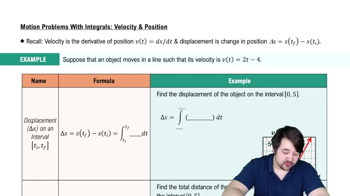
Velocity is the rate of change of an object's position with respect to time, typically expressed in meters per second (m/s). Displacement refers to the change in position of the object over a specific time interval. To find the distance traveled, one must integrate the velocity function over the given time interval, which provides the total displacement.
추천 영상:
가이드 코스
10:17
Using The Velocity Function

Integration

Integration is a fundamental concept in calculus that involves finding the integral of a function, which represents the accumulation of quantities. In the context of velocity, integrating the velocity function over a time interval yields the total distance traveled. The definite integral of the velocity function v(t) from t=a to t=b gives the net displacement during that time period.
추천 영상:
가이드 코스
06:18
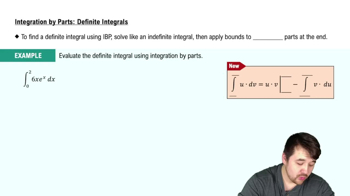
Integration by Parts for Definite Integrals

Definite Integral

A definite integral is an integral that computes the accumulation of a function's values over a specific interval [a, b]. It is denoted as ∫[a to b] f(x) dx and results in a numerical value representing the area under the curve of the function between the limits a and b. In this problem, evaluating the definite integral of the velocity function v(t) from 0 to 3 will provide the total distance traveled by the object.
추천 영상:
가이드 코스
05:43
Definition of the Definite Integral
관련 실천