Determine the area of the shaded region in the following figures.
Ch. 6 - Applications of Integration
6장, 문제 6.1.32
29–36. Position and velocity from acceleration Find the position and velocity of an object moving along a straight line with the given acceleration, initial velocity, and initial position. Use the Fundamental Theorem of Calculus (Theorems 6.1 and 6.2).
a(t) = e^−t; v(0) = 60; s(0) = 40
검증된 단계별 안내1
Identify the given acceleration function: \(a(t) = e^{-t}\), the initial velocity \(v(0) = 60\), and the initial position \(s(0) = 40\).
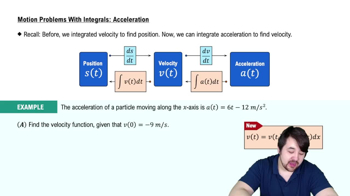
Recall that velocity is the integral of acceleration with respect to time: \(v(t) = \int a(t) \, dt + C_1\). Here, \(C_1\) is the constant of integration that we will find using the initial velocity.
Integrate the acceleration function: \(v(t) = \int e^{-t} \, dt + C_1\). The integral of \(e^{-t}\) is \(-e^{-t}\), so \(v(t) = -e^{-t} + C_1\).
Use the initial velocity condition \(v(0) = 60\) to solve for \(C_1\): substitute \(t=0\) into \(v(t)\) to get \(60 = -e^{0} + C_1\), then solve for \(C_1\).
Next, find the position function by integrating the velocity function: \(s(t) = \int v(t) \, dt + C_2\). Use the initial position \(s(0) = 40\) to solve for the constant of integration \(C_2\).

비슷한 문제에 대한 검증된 영상 답변:
이 영상 해법은 위 문제에 도움이 된다고 튜터들이 추천한 것입니다.
영상 길이:
4m주요 개념
질문에 올바르게 답하기 위해 반드시 이해해야 하는 핵심 개념들은 다음과 같습니다.
Acceleration, Velocity, and Position Relationship
Acceleration is the rate of change of velocity with respect to time, and velocity is the rate of change of position. Given acceleration, velocity can be found by integrating acceleration, and position can be found by integrating velocity. Initial conditions help determine the constants of integration.
추천 영상:
가이드 코스
Using The Acceleration Function
Fundamental Theorem of Calculus
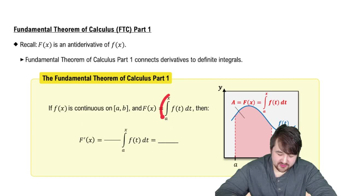
The Fundamental Theorem of Calculus links differentiation and integration, stating that integration can be reversed by differentiation. It allows us to find a function from its derivative by integrating, and use initial values to solve for constants, which is essential when finding velocity and position from acceleration.
추천 영상:
가이드 코스
Fundamental Theorem of Calculus Part 1
Initial Conditions in Differential Equations
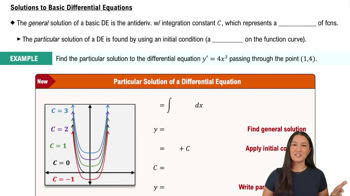
Initial conditions specify the value of a function at a particular point, enabling the determination of integration constants after integrating. For motion problems, initial velocity and position are used to find the exact velocity and position functions from their derivatives.
추천 영상:
Solutions to Basic Differential Equations
관련 실천
교과서 질문
145
views
교과서 질문
64–68. Shell method Use the shell method to find the volume of the following solids.
A hole of radius r≤R is drilled symmetrically along the axis of a bullet. The bullet is formed by revolving the parabola y = 6(1−x²/R²) about the y-axis, where 0≤x≤R.
108
views
교과서 질문
Determine the area of the shaded region in the following figures.
52
views
교과서 질문
A solid has a circular base; cross sections perpendicular to the base are squares. What method should be used to find the volume of the solid?
145
views
교과서 질문
Why is the disk method a special case of the general slicing method?
100
views
교과서 질문
Work from force How much work is required to move an object from x=1 to x=3 (measured in meters) in the presence of a force (in N) given by F(x) = 2x² acting along the x-axis?
84
views