
Ch. 6 - Applications of Integration
Briggs - Calculus: Early Transcendentals 3rd Edition
Briggs3rd EditionCalculus: Early TranscendentalsISBN: 9780136847243당신이 사용하는 게 아니라요?교과서 변경
6장, 문제 6.4.8b

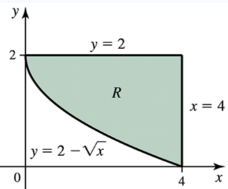
6–8. Let R be the region bounded by the curves y = 2−√x,y=2, and x=4 in the first quadrant.
Graph showing region R bounded by curves y=2, y=2−√x, and line x=4 in the first quadrant.
Suppose the shell method is used to determine the volume of the solid generated by revolving R about the line x=4.


b. What is the height of a cylindrical shell at a point x in [0, 4]?

검증된 단계별 안내
1
Step 1: Understand the problem. The region R is bounded by the curves y = 2−√x, y = 2, and x = 4 in the first quadrant. We are tasked with finding the height of a cylindrical shell at a point x in [0, 4] when the region is revolved about the line x = 4 using the shell method.
Step 2: Recall the shell method formula. The height of a cylindrical shell is determined by the vertical distance between the top curve and the bottom curve at a given x-coordinate. In this case, the top curve is y = 2 and the bottom curve is y = 2−√x.
Step 3: Calculate the height of the shell. The height is given by the difference between the top curve and the bottom curve: height = y_top − y_bottom. Substituting the equations, height = 2 − (2−√x).
Step 4: Simplify the expression for the height. Perform the subtraction: height = 2 − 2 + √x, which simplifies to height = √x.
Step 5: Conclude that the height of the cylindrical shell at a point x in [0, 4] is √x. This height will be used in the shell method formula to compute the volume of the solid.

비슷한 문제에 대한 검증된 영상 답변:

이 영상 해법은 위 문제에 도움이 된다고 튜터들이 추천한 것입니다.
영상 길이:
1m

주요 개념

질문에 올바르게 답하기 위해 반드시 이해해야 하는 핵심 개념들은 다음과 같습니다.

Cylindrical Shell Method

The cylindrical shell method is a technique for finding the volume of a solid of revolution. It involves slicing the solid into thin cylindrical shells, which are then integrated to find the total volume. When revolving around a vertical line, the height of each shell is determined by the function defining the region, and the radius is the distance from the axis of rotation.
추천 영상:
07:33
Euler's Method

Height of a Shell

In the context of the shell method, the height of a cylindrical shell at a point x is given by the difference between the upper and lower bounding functions of the region being revolved. For the given region R, the height is calculated as the vertical distance between the line y = 2 and the curve y = 2 - √x, specifically expressed as h(x) = 2 - (2 - √x) = √x.
추천 영상:
가이드 코스
06:51
Derivatives Applied To Acceleration Example 2

Bounded Region

A bounded region in calculus refers to a specific area enclosed by curves or lines on a graph. In this case, region R is bounded by the curves y = 2, y = 2 - √x, and the vertical line x = 4. Understanding the boundaries is crucial for accurately applying integration techniques to find volumes or areas related to the region.
추천 영상:
가이드 코스
07:45
Area of Polar Regions
관련 실천
교과서 질문

For the given regions R₁ and R₂, complete the following steps.


b. Find the area of region R₂ using geometry and the answer to part (a).


R₁is the region in the first quadrant bounded by the line x=1 and the curve y=6x(2−x^2)^2; R₂ is the region in the first quadrant bounded the curve y=6x(2−x^2)^2and the line y=6x.

40
views
교과서 질문

55–58. Marginal cost Consider the following marginal cost functions.


b. Find the additional cost incurred in dollars when production is increased from 500 units to 550 units.


C′(x)=200−0.05x

58
views
교과서 질문

Distance traveled and displacement Suppose an object moves along a line with velocity (in ft/s) v(t)=6−2t, for 0≤t≤6, where t is measured in seconds.


b. Find the displacement of the object on the interval 0≤t≤6.

32
views
교과서 질문

Compressing and stretching a spring Suppose a force of 15 N is required to stretch and hold a spring 0.25 m from its equilibrium position.

b. How much work is required to compress the spring 0.2 m from its equilibrium position?

62
views
교과서 질문

Cycling distance A cyclist rides down a long straight road with a velocity (in m/min) given by v(t) = 400−20t, for 0≤t≤10, where t is measured in minutes.


b. How far does the cyclist travel in the first 10 min?

49
views
교과서 질문

Blood flow A typical human heart pumps 70 mL of blood (the stroke volume) with each beat. Assuming a heart rate of 60 beats/min (1 beat/s), a reasonable model for the outflow rate of the heart is V′(t)=70(1+sin 2πt), where V(t) is the amount of blood (in milliliters) pumped over the interval [0,t],V(0)=0 and t is measured in seconds.


b. Find the function that gives the total blood pumped between t=0 and a future time t>0.

30
views