


Ch. 6 - Applications of Integration
Briggs - Calculus: Early Transcendentals 3rd Edition
Briggs3rd EditionCalculus: Early TranscendentalsISBN: 9780136847243당신이 사용하는 게 아니라요?교과서 변경
6장, 문제 6.6.5a

A surface is generated by revolving the line f(x)=2−x, for 0≤x≤2, about the x-axis. Find the area of the resulting surface in the following ways.


a. Using calculus

검증된 단계별 안내
1
Step 1: Recall the formula for the surface area of a solid of revolution about the x-axis. The formula is: A = 2π ∫[a,b] f(x)√(1 + (f'(x))²) dx, where f(x) is the function being revolved, and f'(x) is its derivative.
Step 2: Identify the function f(x) = 2 - x and its domain [0, 2]. Compute the derivative of f(x): f'(x) = -1.
Step 3: Substitute f(x) and f'(x) into the formula. The integrand becomes: 2π ∫[0,2] (2 - x)√(1 + (-1)²) dx. Simplify the square root term: √(1 + 1) = √2, so the integrand is 2π√2 ∫[0,2] (2 - x) dx.
Step 4: Break down the integral ∫[0,2] (2 - x) dx into two simpler integrals: ∫[0,2] 2 dx - ∫[0,2] x dx. Compute each integral separately using the power rule for integration.
Step 5: Multiply the result of the integral by 2π√2 to find the surface area. This completes the calculation process.

비슷한 문제에 대한 검증된 영상 답변:

이 영상 해법은 위 문제에 도움이 된다고 튜터들이 추천한 것입니다.
영상 길이:
3m
도움이 되었나요?

주요 개념

질문에 올바르게 답하기 위해 반드시 이해해야 하는 핵심 개념들은 다음과 같습니다.

Surface Area of Revolution

The surface area of a solid of revolution is calculated by revolving a curve around an axis. For a function f(x) revolved around the x-axis, the formula is given by A = 2π ∫[a to b] f(x) √(1 + (f'(x))^2) dx, where [a, b] is the interval of x. This formula accounts for both the height of the function and the slope, providing the total surface area generated.
추천 영상:
09:07
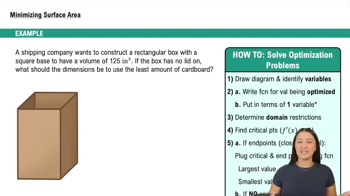
Example 1: Minimizing Surface Area

Definite Integral

A definite integral represents the accumulation of quantities, such as area under a curve, over a specific interval [a, b]. It is denoted as ∫[a to b] f(x) dx and provides a numerical value that corresponds to the total area between the curve f(x) and the x-axis from x = a to x = b. Understanding how to evaluate definite integrals is crucial for calculating surface areas.
추천 영상:
가이드 코스
05:43
Definition of the Definite Integral

Derivative and Its Role

The derivative of a function, denoted as f'(x), measures the rate of change of the function with respect to x. In the context of surface area, the derivative is used to find the slope of the curve, which is essential for the formula involving √(1 + (f'(x))^2). This term adjusts the length of the curve segment being revolved, ensuring accurate surface area calculations.
추천 영상:
관련 실천
교과서 질문

2–3. Displacement, distance, and position Consider an object moving along a line with the following velocities and initial positions. Assume time t is measured in seconds and velocities have units of m/s.


d. Determine the position function s(t) using the Fundamental Theorem of Calculus (Theorem 6.1). Check your answer by finding the position function using the antiderivative method.


v(t) = 12t²-30t+12, for 0 ≤ t ≤ 3; s(0)=1

47
views
교과서 질문

Explain why or why not Determine whether the following statements are true and give an explanation or counterexample.

c. If water flows into a tank at a constant rate (for example, 6 gal/min), the volume of water in the tank increases according to a linear function of time.

33
views
교과서 질문

Oscillating growth rates Some species have growth rates that oscillate with an (approximately) constant period P. Consider the growth rate function N'(t) = r+A sin 2πt/P, where A and r are constants with units of individuals/yr, and t is measured in years. A species becomes extinct if its population ever reaches 0 after t=0.


a. Suppose P=10, A=20, and r=0. If the initial population is N(0)=10, does the population ever become extinct? Explain.

51
views
교과서 질문

Filling a tank A 2000-liter cistern is empty when water begins flowing into it (at t=0 at a rate (in L/min) given by Q′(t) = 3√t, where t is measured in minutes.


a. How much water flows into the cistern in 1 hour?

68
views
교과서 질문

Work in a gravitational field For large distances from the surface of Earth, the gravitational force is given by F(x) = GMm / (x+R)², where G = 6.7×10^−11 N m²/kg² is the gravitational constant, M = 6×10^24 kg is the mass of Earth, m is the mass of the object in the gravitational field, R = 6.378×10⁶ m is the radius of Earth, and x≥0 is the distance above the surface of Earth (in meters).


a. How much work is required to launch a rocket with a mass of 500 kg in a vertical flight path to a height of 2500 km (from Earth’s surface)?

73
views
교과서 질문

70–72. Variable density in one dimension Find the mass of the following thin bars.


A bar on the interval 0≤x≤6 with a density ρ(x) = {1 if 0 ≤ x < 2

2 if 2 ≤ x < 4

4 if 4 ≤ x ≤ 6

48
views