
Ch. 6 - Applications of Integration
Briggs - Calculus: Early Transcendentals 3rd Edition
Briggs3rd EditionCalculus: Early TranscendentalsISBN: 9780136847243당신이 사용하는 게 아니라요?교과서 변경
6장, 문제 6.1.37c

Acceleration A drag racer accelerates at a(t)=88 ft/s². Assume v(0)=0, s(0)=0, and t is measured in seconds.


c. At this rate, how long will it take the racer to travel 1/4 mi?

검증된 단계별 안내
1
Identify the given acceleration function: \(a(t) = 88\) ft/s², which is constant.
Since acceleration is the derivative of velocity, integrate \(a(t)\) with respect to \(t\) to find the velocity function \(v(t)\): \[v(t) = \int a(t) \, dt = \int 88 \, dt = 88t + C_1\] Use the initial condition \(v(0) = 0\) to solve for \(C_1\).
Next, velocity is the derivative of position, so integrate \(v(t)\) to find the position function \(s(t)\): \[s(t) = \int v(t) \, dt = \int 88t \, dt = 44t^2 + C_2\] Use the initial condition \(s(0) = 0\) to solve for \(C_2\).
Convert the distance to consistent units: Since \(1\) mile = \(5280\) feet, \(\frac{1}{4}\) mile = \(\frac{1}{4} \times 5280 = 1320\) feet.
Set the position function equal to \(1320\) feet and solve for \(t\): \[44t^2 = 1320\] Solve this equation to find the time \(t\) it takes to travel \(\frac{1}{4}\) mile.

비슷한 문제에 대한 검증된 영상 답변:

이 영상 해법은 위 문제에 도움이 된다고 튜터들이 추천한 것입니다.
영상 길이:
4m

주요 개념

질문에 올바르게 답하기 위해 반드시 이해해야 하는 핵심 개념들은 다음과 같습니다.

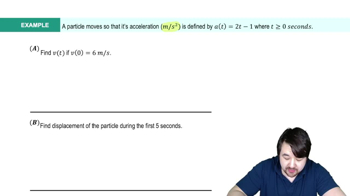
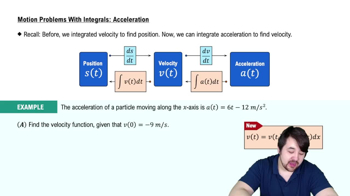
Acceleration and Its Relationship to Velocity and Displacement

Acceleration is the rate of change of velocity with respect to time. Given a constant acceleration, velocity can be found by integrating acceleration over time, and displacement can be found by integrating velocity. This relationship allows us to determine how velocity and position evolve from acceleration.
추천 영상:
가이드 코스
08:56
Using The Acceleration Function Example 1

Integration of Constant Acceleration

When acceleration is constant, velocity increases linearly over time, and displacement follows a quadratic function of time. Specifically, velocity is a(t) multiplied by time plus initial velocity, and displacement is (1/2) times acceleration times time squared plus initial displacement.
추천 영상:
가이드 코스
08:14
Using The Acceleration Function

Unit Conversion and Distance Measurement

To solve for time when given a distance in miles, it is essential to convert miles to feet to match the units of acceleration (ft/s²). Since 1 mile equals 5280 feet, converting 1/4 mile to feet ensures consistent units for accurate calculation.
추천 영상:
5:10
Evaluate Composite Functions - Values on Unit Circle
관련 실천
교과서 질문

A nonlinear spring Hooke’s law is applicable to idealized (linear) springs that are not stretched or compressed too far from their equilibrium positions. Consider a nonlinear spring whose restoring force is given by F(x) = 16x−0.1x³, for |x|≤7. 

c. How much work is done in compressing the spring from its equilibrium position (x=0) to x=−2?

89
views
교과서 질문

6–8. Let R be the region bounded by the curves y = 2−√x,y=2, and x=4 in the first quadrant.

Suppose the shell method is used to determine the volume of the solid generated by revolving R about the line x=4.

c. Write an integral for the volume of the solid using the shell method.

68
views
교과서 질문

Oscillating growth rates Some species have growth rates that oscillate with an (approximately) constant period P. Consider the growth rate function N'(t) = r+A sin 2πt/P, where A and r are constants with units of individuals/yr, and t is measured in years. A species becomes extinct if its population ever reaches 0 after t=0.


c. Suppose P=10, A=50, and r=5. If the initial population is N(0)=10, does the population ever become extinct? Explain.

42
views
교과서 질문

Explain why or why not Determine whether the following statements are true and give an explanation or counterexample.

c. The work required to lift a 10-kg object vertically 10 m is the same as the work required to lift a 20-kg object vertically 5 m.

49
views
교과서 질문

13–16. Displacement from velocity Consider an object moving along a line with the given velocity v. Assume time t is measured in seconds and velocities have units of m/s.


c. Find the distance traveled over the given interval.


v(t) = 4t³ - 24t²+20t on [0, 5]

67
views
교과서 질문

Explain why or why not Determine whether the following statements are true and give an explanation or counterexample.


Arc length may be negative if f(x) < 0 on part of the interval in question.

72
views