Ch. 6 - Applications of Integration
Briggs - Calculus: Early Transcendentals 3rd Edition
Briggs3rd EditionCalculus: Early TranscendentalsISBN: 9780136847243당신이 사용하는 게 아니라요?교과서 변경
6장, 문제 6.6.3

Assume f is a nonnegative function with a continuous first derivative on [a, b]. The curve y=f(x) on [a, b] is revolved about the x-axis. Explain how to find the area of the surface that is generated.

검증된 단계별 안내
1
Step 1: Recall the formula for the surface area of a curve revolved about the x-axis. The surface area, S, is given by: S = ∫ab 2πf(x)√(1 + (f'(x))²) dx. This formula accounts for the curve's length and its distance from the axis of rotation.
Step 2: Identify the function f(x) and its domain [a, b]. Ensure that f(x) is nonnegative and has a continuous first derivative on the interval [a, b], as these are necessary conditions for applying the formula.
Step 3: Compute the derivative of the function, f'(x). This derivative will be used in the formula to account for the slope of the curve, which affects the surface area.
Step 4: Substitute f(x) and f'(x) into the formula for S. The integral becomes: S = ∫ab 2πf(x)√(1 + (f'(x))²) dx. This integral represents the total surface area of the curve revolved about the x-axis.
Step 5: Evaluate the integral using appropriate techniques, such as substitution or numerical methods, depending on the complexity of f(x) and f'(x). This will yield the surface area of the generated surface.

비슷한 문제에 대한 검증된 영상 답변:

이 영상 해법은 위 문제에 도움이 된다고 튜터들이 추천한 것입니다.
영상 길이:
2m
도움이 되었나요?

주요 개념

질문에 올바르게 답하기 위해 반드시 이해해야 하는 핵심 개념들은 다음과 같습니다.

Surface Area of Revolution

The surface area of a solid of revolution is calculated by revolving a curve around an axis. For a function f(x) revolved around the x-axis, the formula involves integrating the circumference of circular slices of the solid. The surface area S can be expressed as S = 2π ∫[a, b] f(x) √(1 + (f'(x))^2) dx, where f'(x) is the derivative of f.
추천 영상:
09:07
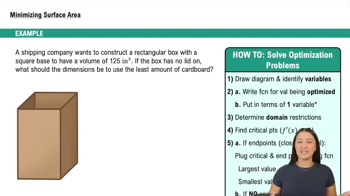
Example 1: Minimizing Surface Area

Continuous First Derivative

A function having a continuous first derivative means that the function is smooth and does not have any sharp corners or discontinuities over the interval [a, b]. This property ensures that the function behaves predictably, which is crucial for accurately calculating the surface area, as it affects the shape of the solid formed when the curve is revolved.
추천 영상:
07:09
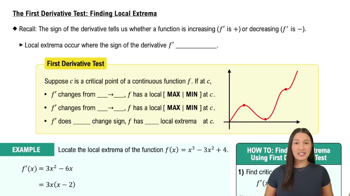
The First Derivative Test: Finding Local Extrema

Integration

Integration is a fundamental concept in calculus used to find areas under curves and other quantities. In the context of finding the surface area of revolution, integration allows us to sum up the infinitesimally small surface areas generated by revolving each segment of the curve. The definite integral from a to b provides the total surface area of the solid formed.
추천 영상:
가이드 코스
06:18
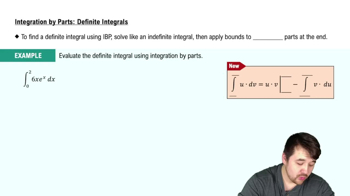
Integration by Parts for Definite Integrals