

Ch. 6 - Applications of Integration
Briggs - Calculus: Early Transcendentals 3rd Edition
Briggs3rd EditionCalculus: Early TranscendentalsISBN: 9780136847243당신이 사용하는 게 아니라요?교과서 변경
6장, 문제 6.1.50a

Blood flow A typical human heart pumps 70 mL of blood (the stroke volume) with each beat. Assuming a heart rate of 60 beats/min (1 beat/s), a reasonable model for the outflow rate of the heart is V′(t)=70(1+sin 2πt), where V(t) is the amount of blood (in milliliters) pumped over the interval [0,t],V(0)=0 and t is measured in seconds.


a. Verify that the amount of blood pumped over a one-second interval is 70 mL.

검증된 단계별 안내
1
Understand that the function \(V'(t) = 70(1 + \sin 2\pi t)\) represents the rate of blood flow in milliliters per second at time \(t\), and \(V(t)\) is the total volume pumped from time 0 to time \(t\).
To find the total amount of blood pumped over the interval from \(t=0\) to \(t=1\) second, we need to integrate the rate function \(V'(t)\) over this interval. This means calculating \(V(1) - V(0) = \int_0^1 V'(t) \, dt\).
Set up the integral: \(\int_0^1 70(1 + \sin 2\pi t) \, dt\). This integral can be split into two parts: \(70 \int_0^1 1 \, dt + 70 \int_0^1 \sin 2\pi t \, dt\).
Evaluate each integral separately: the first integral \(\int_0^1 1 \, dt\) is straightforward, and the second integral \(\int_0^1 \sin 2\pi t \, dt\) involves the sine function with a frequency of \(2\pi\).
Add the results of the two integrals and multiply by 70 to find the total volume pumped over one second. This value should verify that the amount of blood pumped in one second is 70 mL.

비슷한 문제에 대한 검증된 영상 답변:

이 영상 해법은 위 문제에 도움이 된다고 튜터들이 추천한 것입니다.
영상 길이:
3m

주요 개념

질문에 올바르게 답하기 위해 반드시 이해해야 하는 핵심 개념들은 다음과 같습니다.

Derivative as Rate of Change

The derivative of a function represents the instantaneous rate of change of the quantity with respect to time. In this problem, V′(t) models the rate at which blood volume is pumped at time t, allowing us to understand how the volume changes moment by moment.
추천 영상:
가이드 코스
04:16
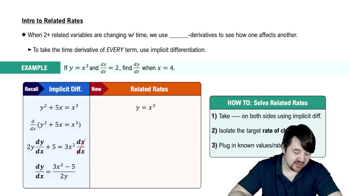
Intro To Related Rates

Definite Integral and Accumulated Quantity

The definite integral of a rate function over an interval gives the total accumulated amount over that time. Here, integrating V′(t) from 0 to 1 second yields the total blood volume pumped in that interval, which should match the stroke volume.
추천 영상:
가이드 코스
05:43
Definition of the Definite Integral

Properties of the Sine Function in Modeling

The sine function models periodic behavior, such as the heartbeat. Its integral over one full period is zero, which helps simplify calculations by isolating the constant term in V′(t), confirming the average flow rate corresponds to the stroke volume.
추천 영상:
가이드 코스
06:21
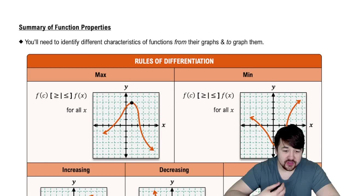
Properties of Functions
관련 실천
교과서 질문

40–43. Population growth


A culture of bacteria in a Petri dish has an initial population of 1500 cells and grows at a rate (in cells/day) of N′(t) = 100e^−0.25t. Assume t is measured in days.


a. What is the population after 20 days? After 40 days?

42
views
교과서 질문

Emptying a conical tank A water tank is shaped like an inverted cone with height 6 m and base radius 1.5 m (see figure).

a. If the tank is full, how much work is required to pump the water to the level of the top of the tank and out of the tank?

154
views
교과서 질문

Flow rates in the Spokane River The daily discharge of the Spokane River as it flows through Spokane, Washington, in April and June is modeled by the functions

r1(t) = 0.25t²+37.46t+722.47 (April) and

r2(t) = 0.90t²−69.06t+2053.12 (June), where the discharge is measured in millions of cubic feet per day, and t=0 corresponds to the beginning of the first day of the month (see figure).

a. Determine the total amount of water that flows through Spokane in April (30 days). 

44
views
교과서 질문

17–22. Position from velocity Consider an object moving along a line with the given velocity v and initial position.


a. Determine the position function, for t≥0, using the antiderivative method


v(t) = −t³+3t²−2t on [0, 3]; s(0)=4

33
views
교과서 질문

{Use of Tech} Oscillating motion A mass hanging from a spring is set in motion, and its ensuing velocity is given by v(t) = 2π cos πt, for t≥0. Assume the positive direction is upward and s(0)=0. 


a. Determine the position function, for t≥0.

68
views
교과서 질문

For the given regions R₁ and R₂, complete the following steps.


a. Find the area of region R₁.


R₁ is the region in the first quadrant bounded by the y-axis and the curves y=2x^2 and y=3−x; R₂ is the region in the first quadrant bounded by the x-axis and the curves y=2x^2 and y=3−x(see figure).

47
views