
Ch. 6 - Applications of Integration
Briggs - Calculus: Early Transcendentals 3rd Edition
Briggs3rd EditionCalculus: Early TranscendentalsISBN: 9780136847243당신이 사용하는 게 아니라요?교과서 변경
6장, 문제 6.7.23d

Compressing and stretching a spring Suppose a force of 30 N is required to stretch and hold a spring 0.2 m from its equilibrium position.
d. How much additional work is required to stretch the spring 0.2m if it has already been stretched 0.2m from its equilibrium position?

검증된 단계별 안내
1
Identify the spring constant \( k \) using Hooke's Law, which states that the force \( F \) required to stretch or compress a spring is proportional to the displacement \( x \) from its equilibrium position: \( F = kx \). Given \( F = 30 \) N and \( x = 0.2 \) m, solve for \( k \) by rearranging the formula to \( k = \frac{F}{x} \).
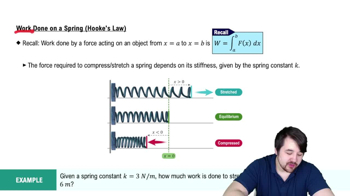
Recall the formula for the work done in stretching or compressing a spring from position \( x = a \) to \( x = b \), which is given by the integral of the force over the displacement: \( W = \int_{a}^{b} kx \, dx \).
Set the limits of integration to represent the additional stretch from \( 0.2 \) m to \( 0.4 \) m, since the spring is already stretched 0.2 m and we want the work to stretch it an additional 0.2 m.
Evaluate the integral \( W = \int_{0.2}^{0.4} kx \, dx \) by finding the antiderivative \( \frac{kx^2}{2} \) and then computing the difference \( \frac{k(0.4)^2}{2} - \frac{k(0.2)^2}{2} \).
Interpret the result as the additional work required to stretch the spring from 0.2 m to 0.4 m beyond its equilibrium position.

비슷한 문제에 대한 검증된 영상 답변:

이 영상 해법은 위 문제에 도움이 된다고 튜터들이 추천한 것입니다.
영상 길이:
2m
도움이 되었나요?

주요 개념

질문에 올바르게 답하기 위해 반드시 이해해야 하는 핵심 개념들은 다음과 같습니다.

Hooke's Law

Hooke's Law states that the force needed to stretch or compress a spring is proportional to the displacement from its equilibrium position, expressed as F = kx, where k is the spring constant and x is the displacement. This law helps determine the spring constant from the given force and displacement.
추천 영상:
가이드 코스
05:40
Work Done On A Spring (Hooke's Law)

Work Done by a Variable Force

The work done in stretching or compressing a spring is calculated by integrating the force over the displacement, since the force varies with position. For a spring, work W = (1/2) k x^2, representing the energy stored in the spring when stretched or compressed.
추천 영상:
가이드 코스
05:40
Work Done On A Spring (Hooke's Law)

Additional Work for Incremental Stretching

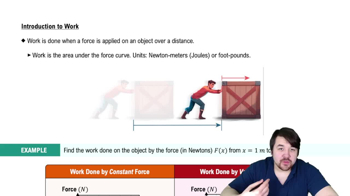
To find the additional work required to stretch a spring further from an already stretched position, calculate the difference in work done between the final and initial displacements. This accounts for the extra energy needed beyond the initial stretch.
추천 영상:
가이드 코스
06:22
Introduction To Work
관련 실천
교과서 질문

Displacement and distance from velocity Consider the velocity function shown below of an object moving along a line. Assume time is measured in seconds and distance is measured in meters. The areas of four regions bounded by the velocity curve and the t-axis are also given.


e. Describe the position of the object relative to its initial position after 8 seconds.

61
views
교과서 질문

Explain why or why not Determine whether the following statements are true and give an explanation or counterexample.


d. A particular marginal cost function has the property that it is positive and decreasing. The cost of increasing production from A units to 2A units is greater than the cost of increasing production from 2A units to 3A units.

43
views
교과서 질문

Displacement and distance from velocity Consider the velocity function shown below of an object moving along a line. Assume time is measured in seconds and distance is measured in meters. The areas of four regions bounded by the velocity curve and the t-axis are also given.

d. What is the displacement of the object over the interval [0, 8]? 

75
views
교과서 질문

Where do they meet? Kelly started at noon (t=0) riding a bike from Niwot to Berthoud, a distance of 20 km, with velocity v(t) = 15 / (t + 1)² (decreasing because of fatigue). Sandy started at noon (t=0) riding a bike in the opposite direction from Berthoud to Niwot with velocity u(t) = 20 / (t + 1)² (also decreasing because of fatigue). Assume distance is measured in kilometers and time is measured in hours.


d. More generally, if the riders’ speeds are v(t)=A(t+1)² and u(t)=B(t+1)² and the distance between the towns is D, what conditions on A, B, and D must be met to ensure that the riders will pass each other?

50
views
교과서 질문

Piecewise velocity The velocity of a (fast) automobile on a straight highway is given by the function

v(t)={3t if 0t<2060 if 20t<452404t if t45 v(t)= \(\begin{cases}\)3 t & \(\text\) { if } 0 \(\leq\) t<20 \\ 60 & \(\text\) { if } 20 \(\leq\) t<45 \\ 240-4 t & \(\text\) { if } t \(\geq\) 45\(\end{cases}\)

where is measured in seconds and v has units of m/s. 

d. What is the position of the automobile when t=75?

48
views
교과서 질문

Displacement and distance from velocity Consider the graph shown in the figure, which gives the velocity of an object moving along a line. Assume time is measured in hours and distance is measured in miles. The areas of three regions bounded by the velocity curve and the t-axis are also given.

d. What is the displacement of the object over the interval [0,5]?

117
views