Ch. 6 - Applications of Integration
Briggs - Calculus: Early Transcendentals 3rd Edition
Briggs3rd EditionCalculus: Early TranscendentalsISBN: 9780136847243당신이 사용하는 게 아니라요?교과서 변경
6장, 문제 6.6.23a

Determine whether the following statements are true and give an explanation or counterexample. 


a. If the curve y=f(x) on the interval [a, b] is revolved about the y-axis, the area of the surface generated is ∫f(b)f(a) 2πf(y)√1+f′(y)^2 dy.

검증된 단계별 안내
1
Step 1: Understand the problem context. The problem involves finding the surface area generated by revolving a curve about the y-axis. The curve is given by y = f(x) on the interval [a, b]. We need to verify if the given integral expression for the surface area is correct.
Step 2: Recall the formula for the surface area when revolving a curve about the y-axis. If the curve is expressed as x = g(y) (i.e., x as a function of y), then the surface area S is given by: \(S = \int_{c}^{d} 2\pi x \sqrt{1 + \left(\frac{dx}{dy}\right)^2} \, dy\) where [c, d] is the interval for y.
Step 3: Note that the problem gives the curve as y = f(x), so to use the formula revolving around the y-axis in terms of y, we need to express x as a function of y, i.e., find the inverse function x = f^{-1}(y). Then, the derivative \(\frac{dx}{dy}\) is the derivative of the inverse function.
Step 4: Compare the given integral \(\int_{f(b)}^{f(a)} 2\pi f(y) \sqrt{1 + (f'(y))^2} \, dy\) with the correct formula. Notice that the integrand uses \(f(y)\) and \(f'(y)\), but since f is originally a function of x, \(f(y)\) and \(f'(y)\) do not make sense unless f is inverted. This suggests the given integral is not correctly formulated.
Step 5: Conclusion: The given integral is not the correct formula for the surface area generated by revolving y = f(x) about the y-axis. The correct approach requires expressing x as a function of y and using the formula involving \(x\) and \(\frac{dx}{dy}\). Therefore, the statement is false.

비슷한 문제에 대한 검증된 영상 답변:

이 영상 해법은 위 문제에 도움이 된다고 튜터들이 추천한 것입니다.
영상 길이:
1m
도움이 되었나요?

주요 개념

질문에 올바르게 답하기 위해 반드시 이해해야 하는 핵심 개념들은 다음과 같습니다.

Surface Area of Revolution

The surface area generated by revolving a curve around an axis is found by integrating the circumference of circular slices times the arc length element. For revolution about the y-axis, the formula involves integrating 2π times the radius (x or function of y) multiplied by the differential arc length along y.
추천 영상:
09:07
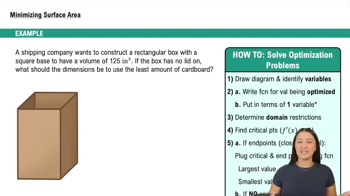
Example 1: Minimizing Surface Area

Parametrization and Variable of Integration

When revolving a curve about the y-axis, the integral is typically expressed in terms of y, requiring the function to be rewritten as x = g(y). The limits of integration correspond to y-values, and the derivative inside the integral must be with respect to y, not x.
추천 영상:
08:02
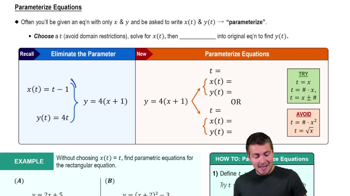
Parameterizing Equations

Arc Length Element in Terms of y

The differential arc length element ds is given by √(1 + (dx/dy)^2) dy when integrating with respect to y. Using f'(y) instead of dx/dy or mixing variables leads to incorrect formulas, so careful differentiation and substitution are essential.
추천 영상:
가이드 코스
06:29
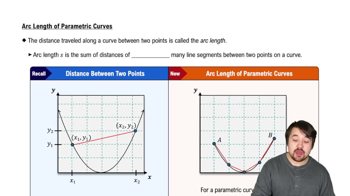
Arc Length of Parametric Curves