

Ch. 6 - Applications of Integration
Briggs - Calculus: Early Transcendentals 3rd Edition
Briggs3rd EditionCalculus: Early TranscendentalsISBN: 9780136847243당신이 사용하는 게 아니라요?교과서 변경
6장, 문제 6.1.12c

Distance traveled and displacement Suppose an object moves along a line with velocity (in ft/s) v(t)=6−2t, for 0≤t≤6, where t is measured in seconds.


c. Find the distance traveled by the object on the interval 0≤t≤6.

검증된 단계별 안내
1
Understand the difference between displacement and distance traveled: displacement is the net change in position, while distance traveled is the total length of the path covered, regardless of direction.
Identify the velocity function given: \(v(t) = 6 - 2t\) for \(0 \leq t \leq 6\). To find distance traveled, we need to consider when the velocity changes sign because the object might change direction.
Find the time when the velocity is zero by solving \(6 - 2t = 0\). This gives the critical point where the object changes direction.
Split the interval \([0,6]\) into subintervals based on the critical point found. On each subinterval, the velocity has a consistent sign, so integrate the absolute value of velocity over each subinterval to find the distance traveled in that segment.
Calculate the total distance traveled by summing the absolute values of the integrals of velocity over each subinterval: \(\text{Distance} = \int_0^{t_0} |v(t)| \, dt + \int_{t_0}^6 |v(t)| \, dt\), where \(t_0\) is the time when velocity is zero.

비슷한 문제에 대한 검증된 영상 답변:

이 영상 해법은 위 문제에 도움이 된다고 튜터들이 추천한 것입니다.
영상 길이:
5m

주요 개념

질문에 올바르게 답하기 위해 반드시 이해해야 하는 핵심 개념들은 다음과 같습니다.

Velocity and Displacement

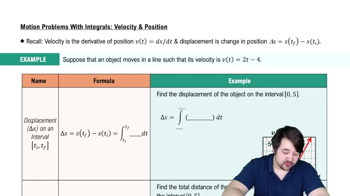
Velocity is the rate of change of position with respect to time and can be positive or negative, indicating direction. Displacement is the net change in position over a time interval and is found by integrating velocity. Understanding the difference between velocity and displacement is crucial for analyzing motion.
추천 영상:
가이드 코스
10:17
Using The Velocity Function

Distance Traveled vs. Displacement

Distance traveled is the total length of the path covered, regardless of direction, while displacement is the straight-line change in position. To find distance traveled from velocity, one must integrate the absolute value of velocity over the time interval, accounting for any changes in direction.
추천 영상:
가이드 코스
08:56
Using The Acceleration Function Example 1

Definite Integrals and Absolute Value

Definite integrals calculate the accumulation of quantities over an interval. When velocity changes sign, the integral of velocity gives displacement, but to find total distance, the integral of the absolute value of velocity is needed. This requires identifying intervals where velocity is positive or negative and integrating accordingly.
추천 영상:
가이드 코스
05:43
Definition of the Definite Integral
관련 실천
교과서 질문

Where do they meet? Kelly started at noon (t=0) riding a bike from Niwot to Berthoud, a distance of 20 km, with velocity v(t) = 15 / (t + 1)² (decreasing because of fatigue). Sandy started at noon (t=0) riding a bike in the opposite direction from Berthoud to Niwot with velocity u(t) = 20 / (t + 1)² (also decreasing because of fatigue). Assume distance is measured in kilometers and time is measured in hours.


c. When do they meet? How far has each person traveled when they meet?

44
views
교과서 질문

Explain why or why not Determine whether the following statements are true and give an explanation or counterexample.

c. If a region is revolved about the x-axis, then in principle, it is possible to use the disk/washer method and integrate with respect to x or to use the shell method and integrate with respect to y.

63
views
교과서 질문

Filling a tank A 2000-liter cistern is empty when water begins flowing into it (at t=0 at a rate (in L/min) given by Q′(t) = 3√t, where t is measured in minutes.


c. When will the tank be full?

35
views
교과서 질문

Emptying a water trough A water trough has a semicircular cross section with a radius of 0.25 m and a length of 3 m (see figure).

c. If the radius is doubled, is the required work doubled? Explain.

65
views
교과서 질문

Blood flow A typical human heart pumps 70 mL of blood (the stroke volume) with each beat. Assuming a heart rate of 60 beats/min (1 beat/s), a reasonable model for the outflow rate of the heart is V′(t)=70(1+sin 2πt), where V(t) is the amount of blood (in milliliters) pumped over the interval [0,t],V(0)=0 and t is measured in seconds.


c. What is the cardiac output over a period of 1 min? (Use calculus; then check your answer with algebra.)

97
views
교과서 질문

Depletion of natural resources Suppose r(t) = r0e^−kt, with k>0, is the rate at which a nation extracts oil, where r0=10⁷ barrels/yr is the current rate of extraction. Suppose also that the estimate of the total oil reserve is 2×10⁹ barrels. 


c. Find the minimum decay constant k for which the total oil reserves will last forever.

88
views