Ch. 6 - Applications of Integration
Briggs - Calculus: Early Transcendentals 3rd Edition
Briggs3rd EditionCalculus: Early TranscendentalsISBN: 9780136847243당신이 사용하는 게 아니라요?교과서 변경
6장, 문제 6.4.72b

Equal integrals Without evaluating integrals, explain the following equalities. (Hint: Draw pictures.)


b. ∫²₀(25−(x²+1)²) dx = 2∫₁⁵ y√y−1 dy

검증된 단계별 안내
1
Step 1: Observe the integral on the left-hand side, ∫₂₀(25−(x²+1)²) dx. This represents the area under the curve defined by the function f(x) = 25−(x²+1)² over the interval [0, 2]. The function is symmetric about the y-axis, and its shape suggests a geometric interpretation.
Step 2: Rewrite the integral on the right-hand side, 2∫₁⁵ y√y−1 dy. This represents twice the area under the curve defined by g(y) = y√y−1 over the interval [1, 5]. The factor of 2 indicates symmetry or a doubling of the area.
Step 3: Use the hint to draw pictures. For the left-hand side, sketch the curve f(x) = 25−(x²+1)², which is a parabola-like shape inverted due to the negative sign. For the right-hand side, sketch the curve g(y) = y√y−1, which is a function involving a square root and grows as y increases.
Step 4: Analyze the symmetry and transformations. The integral on the left-hand side can be interpreted geometrically as the area of a region that corresponds to the integral on the right-hand side after a change of variables. Specifically, the substitution x²+1 ↔ y and adjustments to limits of integration align the two integrals.
Step 5: Conclude that the equality holds because the two integrals represent the same geometric area under their respective curves, albeit expressed in different coordinate systems. The factor of 2 in the right-hand side accounts for symmetry or doubling of the area.

비슷한 문제에 대한 검증된 영상 답변:

이 영상 해법은 위 문제에 도움이 된다고 튜터들이 추천한 것입니다.
영상 길이:
3m
도움이 되었나요?

주요 개념

질문에 올바르게 답하기 위해 반드시 이해해야 하는 핵심 개념들은 다음과 같습니다.

Definite Integrals

Definite integrals represent the signed area under a curve between two points on the x-axis. They are calculated using the Fundamental Theorem of Calculus, which connects differentiation and integration. Understanding the properties of definite integrals, such as linearity and symmetry, is crucial for analyzing equalities involving integrals without direct evaluation.
추천 영상:
가이드 코스
05:43
Definition of the Definite Integral

Substitution Method

The substitution method is a technique used in integration to simplify the process by changing variables. This method involves substituting a part of the integrand with a new variable, which can make the integral easier to evaluate. Recognizing when and how to apply substitution is essential for understanding the relationship between different integrals, as seen in the given equality.
추천 영상:
07:33
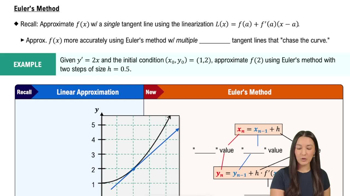
Euler's Method

Geometric Interpretation of Integrals

Integrals can be interpreted geometrically as areas under curves or between curves. Visualizing the functions involved in the integrals can reveal relationships and symmetries that may not be immediately apparent through algebraic manipulation. Drawing diagrams helps in understanding how the areas represented by the integrals relate to each other, which is key to explaining the given equality.
추천 영상:
04:18
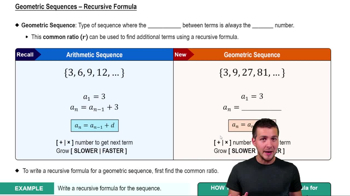
Geometric Sequences - Recursive Formula
관련 실천
교과서 질문

Different axes of revolution Suppose R is the region bounded by y=f(x) and y=g(x) on the interval [a, b], where f(x)≥g(x).


b. How is this formula changed if x0>b?

38
views

교과서 질문

Emptying a cylindrical tank A cylindrical water tank has height 8 m and radius 2m (see figure).

b. Is it true that it takes half as much work to pump the water out of the tank when it is half full as when it is full? Explain.

108
views
교과서 질문

Calculating work for different springs Calculate the work required to stretch the following springs 0.4 m from their equilibrium positions. Assume Hooke’s law is obeyed.

b. A spring that requires 2 J of work to be stretched 0.1 m from its equilibrium position

82
views
교과서 질문

13–16. Displacement from velocity Consider an object moving along a line with the given velocity v. Assume time t is measured in seconds and velocities have units of m/s.


b. Find the displacement over the given interval. 


v(t) = 3t²−6t on [0, 3]

32
views
교과서 질문

Explain why or why not Determine whether the following statements are true and give an explanation or counterexample.


b. When the velocity is positive on an interval, the displacement and the distance traveled on that interval are equal.

34
views
교과서 질문

Determine whether the following statements are true and give an explanation or counterexample. 


b. If f is not one-to-one on the interval [a, b], then the area of the surface generated when the graph of f on [a, b] is revolved about the x-axis is not defined.

42
views