Ch. 6 - Applications of Integration
Briggs - Calculus: Early Transcendentals 3rd Edition
Briggs3rd EditionCalculus: Early TranscendentalsISBN: 9780136847243당신이 사용하는 게 아니라요?교과서 변경
6장, 문제 6.6.13

Find the area of the surface generated when the given curve is revolved about the given axis.


y=√1−x^2, for −1/2≤x≤1/2; about the x-axis

검증된 단계별 안내
1
Step 1: Recall the formula for the surface area of a curve revolved about the x-axis. The formula is: A = 2π ∫[a,b] y √(1 + (dy/dx)^2) dx, where y is the function being revolved, and dy/dx is its derivative.
Step 2: Identify the given function and its interval. Here, y = √(1 − x^2) and the interval is −1/2 ≤ x ≤ 1/2.
Step 3: Compute the derivative of y with respect to x. Using the chain rule, dy/dx = d/dx(√(1 − x^2)) = −x / √(1 − x^2).
Step 4: Substitute y and dy/dx into the surface area formula. Replace y with √(1 − x^2) and dy/dx with −x / √(1 − x^2) in the formula: A = 2π ∫[−1/2,1/2] √(1 − x^2) √(1 + (−x / √(1 − x^2))^2) dx.
Step 5: Simplify the integrand. Combine terms under the square root and simplify: √(1 + (−x / √(1 − x^2))^2) = √(1 + x^2 / (1 − x^2)) = √(1 / (1 − x^2)). The integrand becomes √(1 − x^2) * √(1 / (1 − x^2)) = 1. The integral simplifies to A = 2π ∫[−1/2,1/2] 1 dx.

비슷한 문제에 대한 검증된 영상 답변:

이 영상 해법은 위 문제에 도움이 된다고 튜터들이 추천한 것입니다.
영상 길이:
5m
도움이 되었나요?

주요 개념

질문에 올바르게 답하기 위해 반드시 이해해야 하는 핵심 개념들은 다음과 같습니다.

Surface Area of Revolution

The surface area of revolution is calculated by rotating a curve around an axis. The formula for the surface area generated by revolving a function y = f(x) about the x-axis is given by S = 2π ∫[a to b] f(x) √(1 + (f'(x))^2) dx, where f'(x) is the derivative of f(x). This concept is essential for determining the area of the surface created by the rotation of the curve.
추천 영상:
09:07
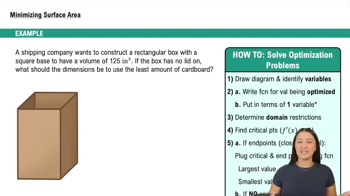
Example 1: Minimizing Surface Area

Parametric Representation

In some cases, curves can be represented parametrically, which involves expressing the coordinates of points on the curve as functions of a parameter. For the given curve y = √(1 - x^2), it can be helpful to consider its parametric form, where x = cos(t) and y = sin(t) for t in the appropriate range. This representation can simplify the integration process when calculating the surface area.
추천 영상:
08:02
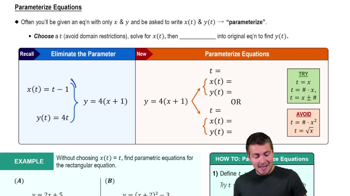
Parameterizing Equations

Definite Integrals

Definite integrals are used to calculate the area under a curve between two specified limits. In the context of finding the surface area of revolution, the definite integral evaluates the accumulated area as the curve is revolved around the axis. Understanding how to set up and compute definite integrals is crucial for solving problems related to surface areas.
추천 영상:
가이드 코스
05:43
Definition of the Definite Integral