Ch. 6 - Applications of Integration
Briggs - Calculus: Early Transcendentals 3rd Edition
Briggs3rd EditionCalculus: Early TranscendentalsISBN: 9780136847243당신이 사용하는 게 아니라요?교과서 변경
6장, 문제 6.7.51

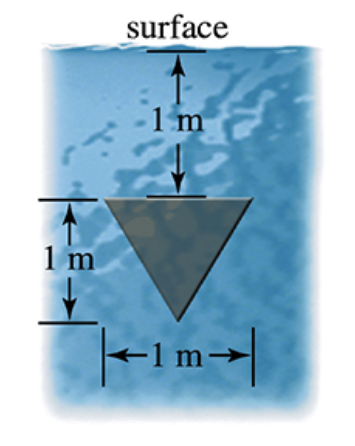
Force on a triangular plate A plate shaped like an isosceles triangle with a height of 1 m is placed on a vertical wall 1 m below the surface of a pool filled with water (see figure). Compute the force on the plate.
<IMAGE>

검증된 단계별 안내
1
Identify the physical context: The force on the triangular plate submerged in water is due to the hydrostatic pressure exerted by the water on the plate's surface.
Recall the hydrostatic pressure formula: The pressure at a depth \(h\) in a fluid of density \(\rho\) under gravity \(g\) is given by \(P = \rho g h\). Here, \(h\) is the vertical distance below the water surface.
Set up a coordinate system: Let \(y\) measure the vertical distance from the water surface downward. The top of the plate is at \(y=1\) m and the bottom at \(y=2\) m.
Express the width of the triangular plate at depth \(y\): Since the plate is an isosceles triangle with height 1 m and base 1 m, the width at depth \(y\) (where \(y\) ranges from 1 to 2) changes linearly. The width \(w(y)\) can be expressed as \(w(y) = 2(y - 1)\) meters, because at \(y=1\) the width is 0 and at \(y=2\) the width is 1 m.
Calculate the force by integrating pressure over the area: The differential force \(dF\) on a thin horizontal strip of thickness \(dy\) at depth \(y\) is \(dF = P(y) \times w(y) \times dy = \rho g y \times w(y) \times dy\). Integrate \(dF\) from \(y=1\) to \(y=2\) to find the total force on the plate.

비슷한 문제에 대한 검증된 영상 답변:

이 영상 해법은 위 문제에 도움이 된다고 튜터들이 추천한 것입니다.
영상 길이:
3m
도움이 되었나요?

주요 개념

질문에 올바르게 답하기 위해 반드시 이해해야 하는 핵심 개념들은 다음과 같습니다.

Hydrostatic Pressure

Hydrostatic pressure is the pressure exerted by a fluid at rest due to the weight of the fluid above it. It increases linearly with depth and is given by the formula P = ρgh, where ρ is the fluid density, g is gravitational acceleration, and h is the depth below the surface.

Force on a Submerged Surface

The force exerted by a fluid on a submerged surface is found by integrating the pressure over the area. Since pressure varies with depth, the total force is the integral of pressure times the differential area, accounting for the shape and orientation of the surface.
추천 영상:
09:07
Example 1: Minimizing Surface Area

Geometry of the Triangular Plate

Understanding the dimensions and shape of the triangular plate is essential to express the width as a function of depth. For an isosceles triangle submerged vertically, the width changes linearly with depth, which is necessary to set up the integral for force calculation.
추천 영상:
가이드 코스
06:35
Changing Geometries