Ch. 6 - Applications of Integration
Briggs - Calculus: Early Transcendentals 3rd Edition
Briggs3rd EditionCalculus: Early TranscendentalsISBN: 9780136847243당신이 사용하는 게 아니라요?교과서 변경
6장, 문제 6.6.39b

In the design of solid objects (both artificial and natural), the ratio of the surface area to the volume of the object is important. Animals typically generate heat at a rate proportional to their volume and lose heat at a rate proportional to their surface area. Therefore, animals with a low SAV ratio tend to retain heat, whereas animals with a high SAV ratio (such as children and hummingbirds) lose heat relatively quickly.


b. What is the SAV ratio of a ball with radius a? 

검증된 단계별 안내
1
Recall the formulas for the surface area and volume of a sphere (ball) with radius \(a\). The surface area \(S\) is given by \(S = 4 \pi a^2\).
The volume \(V\) of the sphere is given by \(V = \frac{4}{3} \pi a^3\).
The surface area to volume (SAV) ratio is defined as \(\frac{S}{V}\), so substitute the formulas for \(S\) and \(V\) into this ratio.
Write the SAV ratio as \(\frac{4 \pi a^2}{\frac{4}{3} \pi a^3}\) and simplify by canceling common factors such as \(4\) and \(\pi\).
After simplification, express the SAV ratio in terms of \(a\) only, which will show how the ratio depends on the radius of the ball.

비슷한 문제에 대한 검증된 영상 답변:

이 영상 해법은 위 문제에 도움이 된다고 튜터들이 추천한 것입니다.
영상 길이:
1m
도움이 되었나요?

주요 개념

질문에 올바르게 답하기 위해 반드시 이해해야 하는 핵심 개념들은 다음과 같습니다.

Surface Area of a Sphere

The surface area of a sphere is calculated using the formula 4πa², where a is the radius. This represents the total area covering the outer layer of the ball, which is crucial for understanding how much heat can be lost through the surface.
추천 영상:
09:07
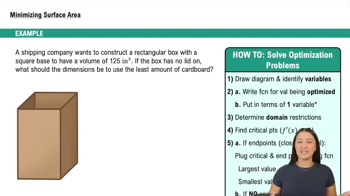
Example 1: Minimizing Surface Area

Volume of a Sphere

The volume of a sphere is given by the formula (4/3)πa³, where a is the radius. This measures the total space inside the ball, which relates to the amount of heat generated within the object.
추천 영상:
04:48
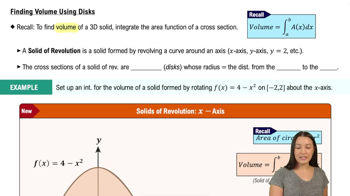
Finding Volume Using Disks

Surface Area to Volume (SAV) Ratio

The SAV ratio is the surface area divided by the volume, indicating how much surface is available per unit volume. For a sphere, this ratio helps explain heat retention or loss, as it compares the heat loss area to the heat-generating volume.
추천 영상:
09:07
Example 1: Minimizing Surface Area
관련 실천
교과서 질문

Deceleration A car slows down with an acceleration of a(t) = −15 ft/s². Assume v(0)=60 ft/s,s(0)=0, and t is measured in seconds.


b. How far does the car travel in the time it takes to come to rest?

31
views

교과서 질문

Use the region R that is bounded by the graphs of y=1+√x,x=4, and y=1 complete the exercises.


Region R is revolved about the y-axis to form a solid of revolution whose cross sections are washers.


b. What is the inner radius of a cross section of the solid at a point y in [1, 3]?

51
views
교과서 질문

Consider the following curves on the given intervals.  


b. Use a calculator or software to approximate the surface area.


y=tan x , for 0≤x≤π/4; about the x-axis 

73
views
교과서 질문

40–43. Population growth


When records were first kept (t=0), the population of a rural town was 250 people. During the following years, the population grew at a rate of P′(t) = 30(1+√t), where t is measured in years.


b. Find the population P(t) at any time t≥0.

24
views
교과서 질문

9–10. Velocity graphs The figures show velocity functions for motion along a line. Assume the motion begins with an initial position of s(0)=0. Determine the following.

b. The distance traveled between t=0 and t=5

99
views
교과서 질문

Probe speed A data collection probe is dropped from a stationary balloon, and it falls with a velocity (in m/s) given by v(t) = 9.8t, neglecting air resistance. After 10 s, a chute deploys and the probe immediately slows to a constant speed of 10 m/s, which it maintains until it enters the ocean.


b. How far does the probe fall in the first 30 s after it is released?

43
views