
교과서 질문
Find the area of the region described in the following exercises.
The region bounded by y=e^x, y=2e^−x+1, and x=0
183
views

 검증된 단계별 안내
 04:48
04:48
 06:30
06:30 05:43
05:43Find the area of the region described in the following exercises.
The region bounded by y=e^x, y=2e^−x+1, and x=0
9-34. Shell method Let R be the region bounded by the following curves. Use the shell method to find the volume of the solid generated when R is revolved about indicated axis.
{Use of Tech} y = In x/x²,y = 0,x = 3, about the y-axis
Let R be the region bounded by the following curves. Find the volume of the solid generated when R is revolved about the given axis.
y=0,y=lnx,y=2, and x=0; about the y-axis
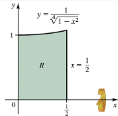
Find the area of the shaded regions in the following figures.
Without evaluating integrals, prove that ∫₀² d/dx(12 sin πx²) dx=∫₀² d/dx (x¹⁰(2−x)³) dx.
9–12. Consider the cylindrical tank in Example 4 that has a height of 10 m and a radius of 5 m. Recall that if the tank is full of water, then ∫₀¹⁰ 25 π ρg(15−y) dy equals the work required to pump all the water out of the tank, through an outflow pipe that is 15 m above the bottom of the tank. Revise this work integral for the following scenarios. (Do not evaluate the integrals.)
The work required to empty the tank through an outflow pipe at the top of the tank