
Ch. 6 - Applications of Integration
Briggs - Calculus: Early Transcendentals 3rd Edition
Briggs3rd EditionCalculus: Early TranscendentalsISBN: 9780136847243당신이 사용하는 게 아니라요?교과서 변경
6장, 문제 6.R.76

Lifting problem A 4-kg mass is attached to the bottom of a 5-m, 15-kg chain. If the chain hangs from a platform, how much work is required to pull the chain and the mass onto the platform?

검증된 단계별 안내
1
Identify the physical setup: a 5-meter chain with mass 15 kg hangs from a platform, and a 4-kg mass is attached at the bottom. We want to find the work done to pull both the chain and the mass up onto the platform.
Calculate the weight per unit length of the chain. Since the chain has mass 15 kg and length 5 m, the linear mass density is \(\lambda = \frac{15}{5} = 3\) kg/m. The weight per unit length is then \(w = \lambda g = 3g\) N/m, where \(g\) is the acceleration due to gravity.
Set up the integral for the work done to lift the chain. Consider a small segment of the chain at a distance \(x\) meters from the bottom (where \(x\) ranges from 0 to 5). The length of chain to be lifted from this segment is \(x\) meters, so the work to lift this segment is \(dW = (\text{weight of segment}) \times (\text{distance lifted})\).
Express the work to lift the chain segment as \(dW = (w \, dx) \times x = 3g x \, dx\). Integrate this expression from \(x=0\) to \(x=5\) to find the total work to lift the entire chain.
Calculate the work to lift the 4-kg mass from the bottom to the platform, which is a distance of 5 meters. The work is \(W_{mass} = mg \times 5 = 4g \times 5\). Add this to the work done lifting the chain to get the total work required.

비슷한 문제에 대한 검증된 영상 답변:

이 영상 해법은 위 문제에 도움이 된다고 튜터들이 추천한 것입니다.
영상 길이:
4m

주요 개념

질문에 올바르게 답하기 위해 반드시 이해해야 하는 핵심 개념들은 다음과 같습니다.

Work Done by a Variable Force

Work is the integral of force over distance. When lifting a chain, the force varies because the weight of the portion lifted changes as more chain is pulled up. Calculating work requires integrating the weight of the chain segment being lifted over the height it is moved.
추천 영상:
가이드 코스
05:40
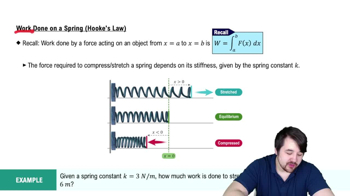
Work Done On A Spring (Hooke's Law)

Weight and Mass Relationship

Weight is the force due to gravity acting on a mass, calculated as mass times gravitational acceleration (W = mg). For the chain and the mass, their weights must be considered separately and combined to find the total force during lifting.
추천 영상:
가이드 코스
09:32
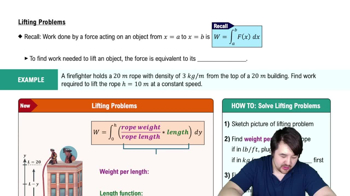
Lifting Problems

Setting up the Integral for Work

To find the total work, set up an integral that sums the incremental work done lifting each small segment of the chain plus the constant work to lift the mass. This involves expressing the force as a function of the height lifted and integrating over the chain length.
추천 영상:
가이드 코스
06:22
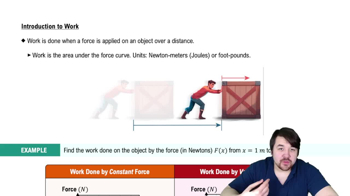
Introduction To Work
관련 실천
교과서 질문

43–55. Volumes of solids Choose the general slicing method, the disk/washer method, or the shell method to answer the following questions.


The region bounded by the curve y = 1+√x, the curve y = 1−√x, and the line x=1 is revolved about the y-axis. Find the volume of the resulting solid by (a) integrating with respect to x and (b) integrating with respect to y. Be sure your answers agree.

39
views
교과서 질문

Two methods The region R in the first quadrant bounded by the parabola y = 4-x² and coordinate axes is revolved about the y-axis to produce a dome-shaped solid. Find the volume of the solid in the following ways:


a. Apply the disk method and integrate with respect to y.

97
views
교과서 질문

Pumping water A water tank has the shape of a box that is 2 m wide, 4 m long, and 6 m high.


b. If the water in the tank is 2 m deep, how much work is required to pump the water to a level of 1 m above the top of the tank?

47
views
교과서 질문

43–55. Volumes of solids Choose the general slicing method, the disk/washer method, or the shell method to answer the following questions.


The region bounded by the graphs of y = 2x,y = 6−x, and y = 0 is revolved about the line y = −2 and the line x = −2. Find the volumes of the resulting solids. Which one is greater?

79
views
교과서 질문

An oscillator The acceleration of an object moving along a line is given by a(t) = 2 sin πt/4. The initial velocity and position are v(0)= −8/π and s(0)=0.

 a. Find the velocity and position for t≥0.

22
views
교과서 질문

58–61. Arc length Find the length of the following curves.

y = x³/6 + 1/2x on [1,2]

77
views