
Ch. 6 - Applications of Integration
Briggs - Calculus: Early Transcendentals 3rd Edition
Briggs3rd EditionCalculus: Early TranscendentalsISBN: 9780136847243당신이 사용하는 게 아니라요?교과서 변경
6장, 문제 6.R.73b

Spring work


b. It takes 50 N of force to stretch a spring 0.2 m from its equilibrium position. How much work is needed to stretch it an additional 0.5 m?

검증된 단계별 안내
1
Identify the spring constant \( k \) using Hooke's Law, which states that the force \( F \) required to stretch or compress a spring by a distance \( x \) is \( F = kx \). Given \( F = 50 \) N and \( x = 0.2 \) m, solve for \( k \) by rearranging the formula to \( k = \frac{F}{x} \).
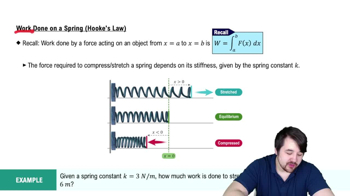
Express the work done to stretch a spring from position \( x = a \) to \( x = b \) using the integral formula for work: \( W = \int_a^b F(x) \, dx \), where \( F(x) = kx \) is the force at position \( x \).
Set the limits of integration to represent the additional stretch: since the spring is already stretched 0.2 m, the work needed to stretch it an additional 0.5 m corresponds to stretching from \( x = 0.2 \) m to \( x = 0.7 \) m (because \( 0.2 + 0.5 = 0.7 \)).
Write the integral for the work done as \( W = \int_{0.2}^{0.7} kx \, dx \). Substitute the value of \( k \) found in step 1 into this integral.
Evaluate the integral \( \int_{0.2}^{0.7} kx \, dx = k \int_{0.2}^{0.7} x \, dx = k \left[ \frac{x^2}{2} \right]_{0.2}^{0.7} \) to find the work done in stretching the spring the additional 0.5 m.

비슷한 문제에 대한 검증된 영상 답변:

이 영상 해법은 위 문제에 도움이 된다고 튜터들이 추천한 것입니다.
영상 길이:
2m
도움이 되었나요?

주요 개념

질문에 올바르게 답하기 위해 반드시 이해해야 하는 핵심 개념들은 다음과 같습니다.

Hooke's Law

Hooke's Law states that the force required to stretch or compress a spring is proportional to the displacement from its equilibrium position, expressed as F = kx, where k is the spring constant and x is the displacement. This law helps determine the spring constant from the given force and displacement.
추천 영상:
가이드 코스
05:40
Work Done On A Spring (Hooke's Law)

Work Done by a Variable Force

When stretching a spring, the force varies with displacement, so work done is calculated by integrating the force over the distance stretched. The work done to stretch a spring from x = a to x = b is W = (1/2)k(b² - a²), reflecting the area under the force-displacement curve.
추천 영상:
가이드 코스
05:40
Work Done On A Spring (Hooke's Law)

Spring Constant Calculation

The spring constant k quantifies the stiffness of the spring and is found by rearranging Hooke's Law: k = F/x. Knowing k allows calculation of work done for any displacement, making it essential to first find k using the initial force and displacement before solving for additional work.
추천 영상:
가이드 코스
05:40
Work Done On A Spring (Hooke's Law)
관련 실천
교과서 질문

Comparing volumes Let R be the region bounded by y=1/x^p and the x-axis on the interval [1, a], where p>0 and a>1 (see figure). Let Vₓ and Vᵧ be the volumes of the solids generated when R is revolved about the x- and y-axes, respectively.


d. Find a general expression for Vᵧ in terms of a and p. Note that p=2 is a special case. What is Vᵧ when p=2?

39
views
교과서 질문

Two methods The region R in the first quadrant bounded by the parabola y = 4-x² and coordinate axes is revolved about the y-axis to produce a dome-shaped solid. Find the volume of the solid in the following ways:


b. Apply the shell method and integrate with respect to x.

59
views
교과서 질문

An area function Consider the functions y = x²/a and y = √x/a, where a>0. Find A(a), the area of the region between the curves.

47
views
교과서 질문

Pumping water A water tank has the shape of a box that is 2 m wide, 4 m long, and 6 m high.


b. If the water in the tank is 2 m deep, how much work is required to pump the water to a level of 1 m above the top of the tank?

47
views
교과서 질문

43–55. Volumes of solids Choose the general slicing method, the disk/washer method, or the shell method to answer the following questions.


The region bounded by the graphs of y = 2x,y = 6−x, and y = 0 is revolved about the line y = −2 and the line x = −2. Find the volumes of the resulting solids. Which one is greater?

79
views
교과서 질문

An oscillator The acceleration of an object moving along a line is given by a(t) = 2 sin πt/4. The initial velocity and position are v(0)= −8/π and s(0)=0.

 a. Find the velocity and position for t≥0.

22
views