Ch. 7 - Logarithmic, Exponential Functions, and Hyperbolic Functions
Briggs - Calculus: Early Transcendentals 3rd Edition
Briggs3rd EditionCalculus: Early TranscendentalsISBN: 9780136847243당신이 사용하는 게 아니라요?교과서 변경
7장, 문제 7.2.13

13–14. Absolute and relative growth rates Two functions f and g are given. Show that the growth rate of the linear function is constant and the relative growth rate of the exponential function is constant.


f(t) = 100 + 10.5t, g(t) = 100e^(t/10)

검증된 단계별 안내
1
Identify the given functions: the linear function \(f(t) = 100 + 10.5t\) and the exponential function \(g(t) = 100e^{\frac{t}{10}}\).
Calculate the growth rate of the linear function \(f(t)\) by finding its derivative with respect to \(t\): \(f'(t) = \frac{d}{dt}(100 + 10.5t)\).
Observe that the derivative \(f'(t)\) is a constant value, which shows that the absolute growth rate of the linear function is constant.
Calculate the relative growth rate of the exponential function \(g(t)\) by first finding its derivative: \(g'(t) = \frac{d}{dt}\left(100e^{\frac{t}{10}}\right)\).
Express the relative growth rate of \(g(t)\) as \(\frac{g'(t)}{g(t)}\) and simplify to show that this ratio is a constant, confirming the relative growth rate of the exponential function is constant.

비슷한 문제에 대한 검증된 영상 답변:

이 영상 해법은 위 문제에 도움이 된다고 튜터들이 추천한 것입니다.
영상 길이:
1m
도움이 되었나요?

주요 개념

질문에 올바르게 답하기 위해 반드시 이해해야 하는 핵심 개념들은 다음과 같습니다.

Absolute Growth Rate

The absolute growth rate of a function measures how much the function's value changes per unit increase in the input variable. For a linear function like f(t) = 100 + 10.5t, this rate is constant and equals the slope, which is 10.5. It represents a steady, fixed increase over time.
추천 영상:
04:16
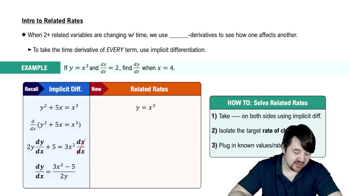
Intro To Related Rates

Relative Growth Rate

The relative growth rate is the rate of change of a function relative to its current value, often expressed as (f'(t)/f(t)). For exponential functions like g(t) = 100e^(t/10), this rate is constant, reflecting proportional growth. It indicates the percentage increase per unit time.
추천 영상:
04:16
Intro To Related Rates

Differentiation of Functions

Differentiation is the process of finding the derivative, which gives the instantaneous rate of change of a function. Calculating derivatives of f(t) and g(t) allows us to determine their growth rates. Understanding how to differentiate linear and exponential functions is essential to analyze their growth behavior.
추천 영상:
05:53
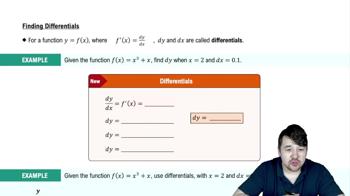
Finding Differentials