Ch. 7 - Logarithmic, Exponential Functions, and Hyperbolic Functions
Briggs - Calculus: Early Transcendentals 3rd Edition
Briggs3rd EditionCalculus: Early TranscendentalsISBN: 9780136847243당신이 사용하는 게 아니라요?교과서 변경
7장, 문제 7.2.18

15–20. Designing exponential growth functions Complete the following steps for the given situation.


a. Find the rate constant k and use it to devise an exponential growth function that fits the given data.
b. Answer the accompanying question.


Savings account An initial deposit of \$1500 is placed in a savings account with an APY of 3.1%. How long will it take until the balance of the account is \$2500? Assume the interest rate remains constant and no additional deposits or withdrawals are made.

검증된 단계별 안내
1
Identify the exponential growth model for continuous compounding interest, which is given by the formula: \(A(t) = A_0 e^{k t}\), where \(A(t)\) is the amount at time \(t\), \(A_0\) is the initial amount, \(k\) is the rate constant, and \(t\) is time in years.
Use the given APY (Annual Percentage Yield) of 3.1% to find the rate constant \(k\). Since APY represents the effective annual growth, set \(A(1) = A_0 e^{k \cdot 1} = A_0 (1 + 0.031)\), and solve for \(k\) by isolating it in the equation \(e^{k} = 1.031\).
Write the exponential growth function using the initial deposit \(A_0 = 1500\) and the rate constant \(k\) found in the previous step: \(A(t) = 1500 e^{k t}\).
To find the time \(t\) when the balance reaches \(2500\), set \(A(t) = 2500\) and solve for \(t\) in the equation \(2500 = 1500 e^{k t}\).
Isolate \(t\) by dividing both sides by 1500, then take the natural logarithm of both sides to get \(\ln\left(\frac{2500}{1500}\right) = k t\), and finally solve for \(t\) as \(t = \frac{\ln\left(\frac{2500}{1500}\right)}{k}\).

비슷한 문제에 대한 검증된 영상 답변:

이 영상 해법은 위 문제에 도움이 된다고 튜터들이 추천한 것입니다.
영상 길이:
2m
도움이 되었나요?

주요 개념

질문에 올바르게 답하기 위해 반드시 이해해야 하는 핵심 개념들은 다음과 같습니다.

Exponential Growth Function

An exponential growth function models quantities that increase at a rate proportional to their current value. It is generally expressed as A(t) = A_0 * e^(kt), where A_0 is the initial amount, k is the growth rate constant, and t is time. This function is essential for modeling continuous compound interest in savings accounts.
추천 영상:
09:29
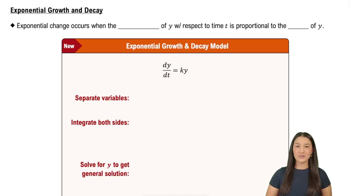
Exponential Growth & Decay

Rate Constant (k) in Continuous Growth

The rate constant k represents the continuous growth rate in the exponential model. It can be derived from the annual percentage yield (APY) using the formula k = ln(1 + APY). Knowing k allows us to write the exact exponential function that describes how the investment grows over time.
추천 영상:
04:16
Intro To Related Rates

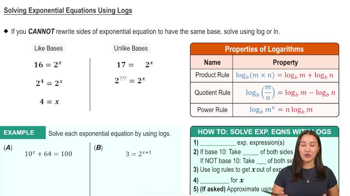
Solving for Time in Exponential Equations

To find the time required for an investment to reach a certain value, we solve the exponential equation for t. This involves isolating t by taking the natural logarithm of both sides, resulting in t = (1/k) * ln(A(t)/A_0). This step is crucial for answering questions about how long it takes for an investment to grow to a target amount.
추천 영상:
5:47
Solving Exponential Equations Using Logs