


Compounded inflation The U.S. government reports the rate of inflation (as measured by the consumer index) both monthly and annually. Suppose for a particular month, the monthly rate of inflation is reported as 0.8%. Assuming this rate remains constant, what is the corresponding annual rate of inflation? Is the annual rate 12 times the monthly rate? Explain.
Ch. 7 - Logarithmic, Exponential Functions, and Hyperbolic Functions
모든 교과서
Briggs 3rd Edition
Ch. 7 - Logarithmic, Exponential Functions, and Hyperbolic Functions
문제 7.3.26
Briggs 3rd Edition
Ch. 7 - Logarithmic, Exponential Functions, and Hyperbolic Functions
문제 7.3.267장, 문제 7.3.26
22–36. Derivatives Find the derivatives of the following functions.
f(x) = √coth 3x
검증된 단계별 안내1
Step 1: Recognize that the function f(x) = √coth(3x) involves a composition of functions. Specifically, it is the square root function applied to the hyperbolic cotangent function, which itself depends on 3x.
Step 2: Use the chain rule to differentiate the outer function √u, where u = coth(3x). The derivative of √u with respect to u is (1 / (2√u)).
Step 3: Differentiate the inner function coth(3x) with respect to x. Recall that the derivative of coth(u) is -csch²(u), where u = 3x. Then apply the chain rule to account for the derivative of 3x, which is 3.
Step 4: Combine the results from Steps 2 and 3. The derivative of f(x) is (1 / (2√coth(3x))) multiplied by the derivative of coth(3x), which is -3csch²(3x).
Step 5: Simplify the expression for the derivative. The final derivative is f'(x) = (-3csch²(3x)) / (2√coth(3x)).

비슷한 문제에 대한 검증된 영상 답변:
이 영상 해법은 위 문제에 도움이 된다고 튜터들이 추천한 것입니다.
영상 길이:
3m도움이 되었나요?
주요 개념
질문에 올바르게 답하기 위해 반드시 이해해야 하는 핵심 개념들은 다음과 같습니다.
Derivatives
A derivative represents the rate of change of a function with respect to its variable. It is a fundamental concept in calculus that allows us to determine the slope of the tangent line to the curve of a function at any given point. The process of finding a derivative is called differentiation, and it involves applying specific rules and formulas, such as the power rule, product rule, and chain rule.
추천 영상:
가이드 코스
Derivatives
Chain Rule
The chain rule is a formula used to compute the derivative of a composite function. If a function is composed of two or more functions, the chain rule states that the derivative of the outer function is multiplied by the derivative of the inner function. This is particularly useful when dealing with functions that involve nested expressions, such as f(g(x)).
추천 영상:
Intro to the Chain Rule
Hyperbolic Functions
Hyperbolic functions, such as coth, sinh, and cosh, are analogs of the trigonometric functions but are based on hyperbolas instead of circles. The function coth(x) is defined as the ratio of the hyperbolic cosine to the hyperbolic sine, and it plays a significant role in calculus, especially in the context of derivatives and integrals involving exponential functions. Understanding their properties is essential for differentiating functions that include hyperbolic terms.
추천 영상:
가이드 코스
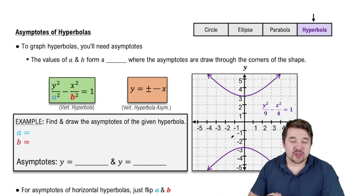
Asymptotes of Hyperbolas
관련 실천
교과서 질문
100
views
교과서 질문
29–62. Integrals Evaluate the following integrals. Include absolute values only when needed.
∫₀^{π/2} 4^{sin x} cos x dx
50
views
교과서 질문
37–56. Integrals Evaluate each integral.
∫₀ ˡⁿ ² tanh x dx
84
views
교과서 질문
7–28. Derivatives Evaluate the following derivatives.
d/dt ((sin t)^{√t})
46
views
교과서 질문
57–58. Two ways
Evaluate the following integrals two ways.
a. Simplify the integrand first and then integrate.
b. Change variables (let u = ln x), integrate, and then simplify your answer. Verify that both methods give the same answer.
∫ (sinh (ln x)) / x dx
39
views
교과서 질문
29–62. Integrals Evaluate the following integrals. Include absolute values only when needed.
∫₀³ (2x - 1) / (x + 1) dx
76
views