
Sag angle Imagine a climber clipping onto the rope described in Example 7 and pulling himself to the rope’s midpoint. Because the rope is supporting the weight of the climber, it no longer takes the shape of the catenary y = 200 cosh x/200. Instead, the rope (nearly) forms two sides of an isosceles triangle. Compute the sag angle θ illustrated in the figure, assuming the rope does not stretch when weighted. Recall from Example 7 that the length of the rope is 101 ft.
Ch. 7 - Logarithmic, Exponential Functions, and Hyperbolic Functions
모든 교과서
Briggs 3rd Edition
Ch. 7 - Logarithmic, Exponential Functions, and Hyperbolic Functions
문제 7.3.29
Briggs 3rd Edition
Ch. 7 - Logarithmic, Exponential Functions, and Hyperbolic Functions
문제 7.3.297장, 문제 7.3.29
22–36. Derivatives Find the derivatives of the following functions.
f(x) = x² cosh² 3x
검증된 단계별 안내1
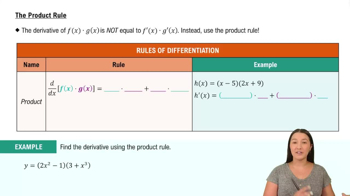
Step 1: Recognize that the function f(x) = x² cosh²(3x) is a product of two functions: u(x) = x² and v(x) = cosh²(3x). To find the derivative, apply the product rule: (uv)' = u'v + uv'.
Step 2: Compute the derivative of u(x) = x². Using the power rule, the derivative is u'(x) = 2x.
Step 3: Compute the derivative of v(x) = cosh²(3x). Use the chain rule. Let w(x) = cosh(3x), so v(x) = w²(x). The derivative of w²(x) is 2w(x)w'(x). Then, find w'(x) = sinh(3x) * 3 using the chain rule for cosh(3x). Substitute back to get v'(x) = 2cosh(3x) * sinh(3x) * 3.
Step 4: Substitute u'(x), v(x), u(x), and v'(x) into the product rule formula: f'(x) = u'(x)v(x) + u(x)v'(x). This becomes f'(x) = (2x)(cosh²(3x)) + (x²)(2cosh(3x) * sinh(3x) * 3).
Step 5: Simplify the expression for f'(x) as needed. The derivative is now expressed in terms of x, cosh(3x), and sinh(3x).

비슷한 문제에 대한 검증된 영상 답변:
이 영상 해법은 위 문제에 도움이 된다고 튜터들이 추천한 것입니다.
영상 길이:
4m도움이 되었나요?
주요 개념
질문에 올바르게 답하기 위해 반드시 이해해야 하는 핵심 개념들은 다음과 같습니다.
Derivatives
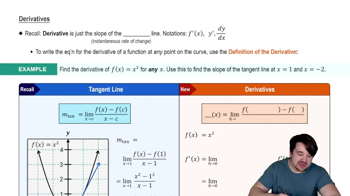
A derivative represents the rate of change of a function with respect to its variable. It is a fundamental concept in calculus that provides information about the slope of the tangent line to the function's graph at any given point. The derivative can be computed using various rules, such as the power rule, product rule, and chain rule, depending on the function's structure.
추천 영상:
가이드 코스
Derivatives
Product Rule
The product rule is a formula used to find the derivative of the product of two functions. It states that if you have two functions, u(x) and v(x), the derivative of their product is given by u'v + uv'. This rule is essential when differentiating functions that are products of simpler functions, as seen in the given function f(x) = x² cosh² 3x.
추천 영상:
The Product Rule
Hyperbolic Functions
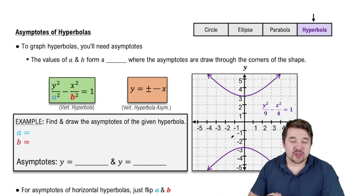
Hyperbolic functions, such as cosh(x), are analogs of trigonometric functions but are based on hyperbolas instead of circles. The function cosh(x) is defined as (e^x + e^(-x))/2 and has unique properties, including its derivatives. Understanding hyperbolic functions is crucial for differentiating expressions involving them, particularly when applying the chain rule in conjunction with the product rule.
추천 영상:
가이드 코스
Asymptotes of Hyperbolas
관련 실천
교과서 질문
56
views
교과서 질문
88–91. Limits Use l’Hôpital’s Rule to evaluate the following limits.
lim x → 0⁺ (tanh x)ˣ
80
views
교과서 질문
What is the domain of sech⁻¹ x? How is sech⁻¹ x defined in terms of the inverse hyperbolic cosine?
115
views
교과서 질문
7–28. Derivatives Evaluate the following derivatives.
d/dx (sin (ln x))
70
views
교과서 질문
63–66. Calculator limits Use a calculator to make a table similar to Table 7.1 to approximate the following limits. Confirm your result with l’Hôpital’s Rule.
limₕ→₀ (1 + 2h)^{1/h}
51
views
교과서 질문
7–28. Derivatives Evaluate the following derivatives.
d/dt (t^{1/t})
95
views