Ch. 7 - Logarithmic, Exponential Functions, and Hyperbolic Functions
Briggs - Calculus: Early Transcendentals 3rd Edition
Briggs3rd EditionCalculus: Early TranscendentalsISBN: 9780136847243당신이 사용하는 게 아니라요?교과서 변경
7장, 문제 7.2.27

27–30. Designing exponential decay functions Devise an exponential decay function that fits the following data; then answer the accompanying questions. Be sure to identify the reference point (t = 0) and units of time.


Crime rate The homicide rate decreases at a rate of 3%/yr in a city that had 800 homicides/yr in 2018. At this rate, when will the homicide rate reach 600 homicides/yr?

검증된 단계별 안내
1
Identify the reference point and variables: Let \( t = 0 \) correspond to the year 2018, and let \( H(t) \) represent the homicide rate (in homicides per year) at time \( t \) years after 2018.
Write the general form of the exponential decay function: Since the homicide rate decreases by 3% per year, the decay factor per year is \( 1 - 0.03 = 0.97 \). Thus, the function can be expressed as \( H(t) = H_0 \times (0.97)^t \), where \( H_0 = 800 \) is the initial homicide rate at \( t = 0 \).
Set up the equation to find when the homicide rate reaches 600: We want to find \( t \) such that \( H(t) = 600 \). Substitute into the function to get \( 600 = 800 \times (0.97)^t \).
Isolate the exponential term: Divide both sides by 800 to get \( \frac{600}{800} = (0.97)^t \), which simplifies to \( 0.75 = (0.97)^t \).
Solve for \( t \) using logarithms: Take the natural logarithm of both sides to obtain \( \ln(0.75) = t \times \ln(0.97) \). Then solve for \( t \) by dividing both sides by \( \ln(0.97) \), giving \( t = \frac{\ln(0.75)}{\ln(0.97)} \).

비슷한 문제에 대한 검증된 영상 답변:

이 영상 해법은 위 문제에 도움이 된다고 튜터들이 추천한 것입니다.
영상 길이:
3m
도움이 되었나요?

주요 개념

질문에 올바르게 답하기 위해 반드시 이해해야 하는 핵심 개념들은 다음과 같습니다.

Exponential Decay Function

An exponential decay function models quantities that decrease at a rate proportional to their current value. It is generally expressed as N(t) = N_0 * e^(-kt), where N_0 is the initial amount, k is the decay constant, and t is time. This function helps predict future values based on a constant percentage decrease over time.
추천 영상:
09:29
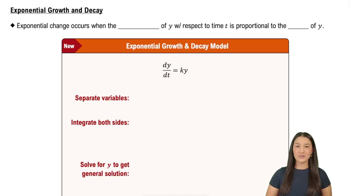
Exponential Growth & Decay

Decay Rate and Decay Constant

The decay rate is the percentage decrease per unit time, here 3% per year. The decay constant k relates to this rate through k = -ln(1 - decay rate). Understanding this relationship allows conversion from a percentage rate to the exponential model's parameter, enabling accurate function formulation.
추천 영상:
09:29
Exponential Growth & Decay

Solving for Time in Exponential Decay

To find when the quantity reaches a specific value, set the exponential decay function equal to that value and solve for time t. This involves isolating t using logarithms, typically natural logs, to invert the exponential function. This step is crucial for predicting when the homicide rate will reach 600.
추천 영상:
09:29
Exponential Growth & Decay