Ch. 7 - Logarithmic, Exponential Functions, and Hyperbolic Functions
Briggs - Calculus: Early Transcendentals 3rd Edition
Briggs3rd EditionCalculus: Early TranscendentalsISBN: 9780136847243당신이 사용하는 게 아니라요?교과서 변경
7장, 문제 7.1.11

7–28. Derivatives Evaluate the following derivatives.


d/dx ((ln 2x)⁻⁵)

검증된 단계별 안내
1
Step 1: Recognize that the given function is ((ln(2x))⁻⁵). This is a composite function, so we will need to use the chain rule to differentiate it.
Step 2: Apply the chain rule. Let u = ln(2x), so the function becomes u⁻⁵. The derivative of u⁻⁵ with respect to u is -5u⁻⁶.
Step 3: Differentiate u = ln(2x) with respect to x. Using the chain rule again, the derivative of ln(2x) is (1/(2x)) * 2, which simplifies to 1/x.
Step 4: Combine the results from Step 2 and Step 3. Multiply the derivative of u⁻⁵ (-5u⁻⁶) by the derivative of u (1/x). Substitute u = ln(2x) back into the expression.
Step 5: The final derivative is -5(ln(2x))⁻⁶ * (1/x). This is the simplified form of the derivative.

비슷한 문제에 대한 검증된 영상 답변:

이 영상 해법은 위 문제에 도움이 된다고 튜터들이 추천한 것입니다.
영상 길이:
2m
도움이 되었나요?

주요 개념

질문에 올바르게 답하기 위해 반드시 이해해야 하는 핵심 개념들은 다음과 같습니다.

Derivatives

A derivative represents the rate of change of a function with respect to a variable. It is a fundamental concept in calculus that allows us to determine how a function behaves as its input changes. The notation d/dx indicates differentiation with respect to the variable x, and derivatives can be computed using various rules, such as the power rule, product rule, and chain rule.
추천 영상:

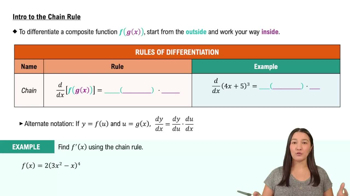
Chain Rule

The chain rule is a formula for computing the derivative of a composite function. If a function y is defined as a function of u, which in turn is a function of x (y = f(u) and u = g(x)), the chain rule states that the derivative dy/dx is the product of the derivative of f with respect to u and the derivative of g with respect to x. This is essential for differentiating functions like (ln(2x))⁻⁵, where the inner function is ln(2x).
추천 영상:
05:02
Intro to the Chain Rule

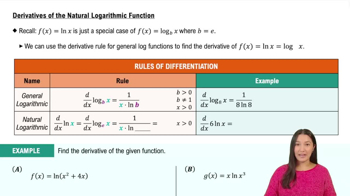
Natural Logarithm

The natural logarithm, denoted as ln, is the logarithm to the base e, where e is approximately 2.71828. It is an important function in calculus, particularly in differentiation and integration. The derivative of ln(x) is 1/x, and when dealing with expressions involving ln, understanding its properties and how to differentiate it is crucial for solving problems involving logarithmic functions.
추천 영상:
05:18
Derivative of the Natural Logarithmic Function